Photographing a snow leopard in the wild is one of the greatest challenges for wildlife photographers. This field guide features professional wildlife photographer SIJI (@ATIMESIJI), who shares his experience photographing this elusive mountain predator.
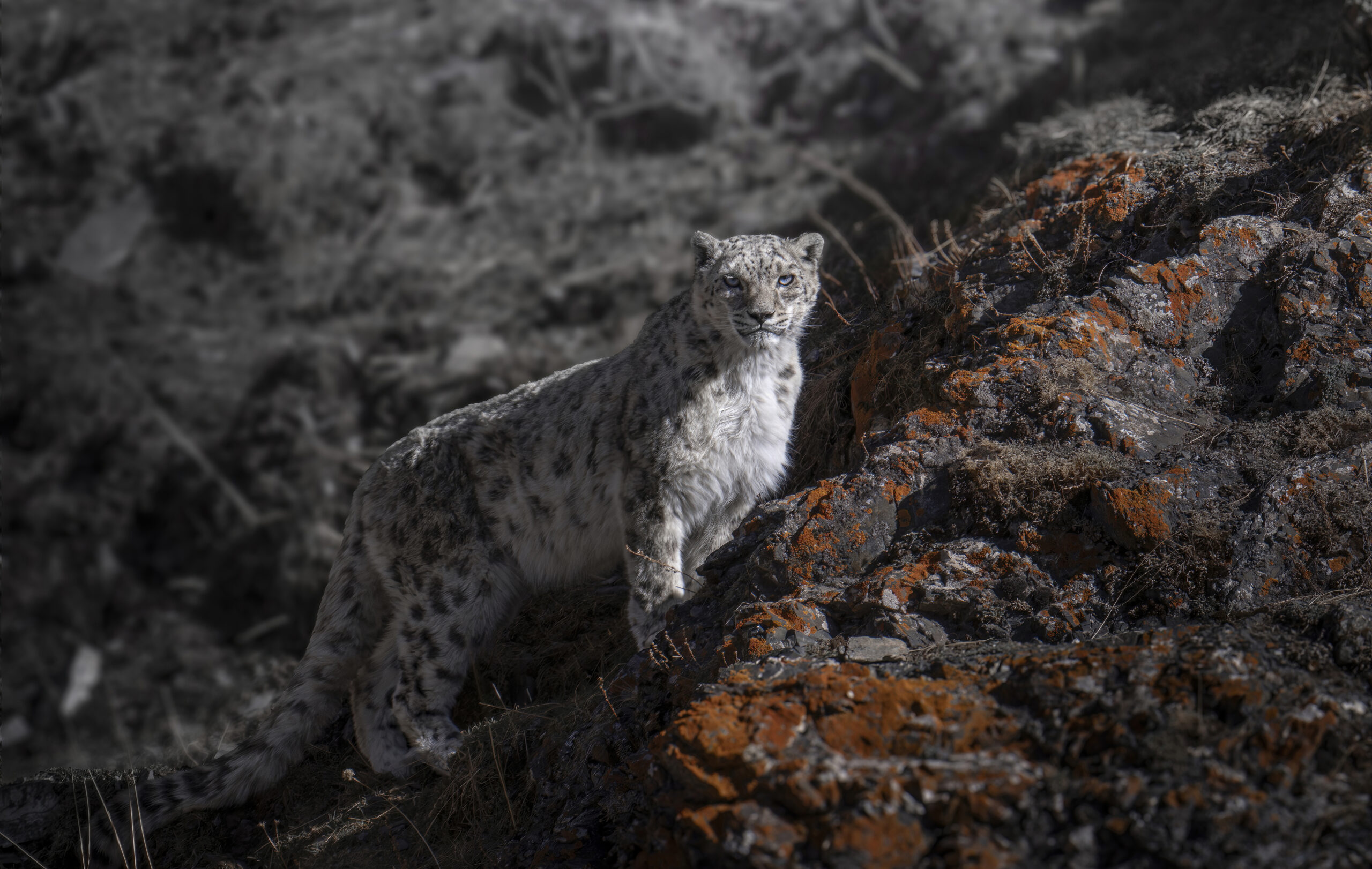
From understanding why snow leopards are so difficult to photograph, to capturing the rarely seen moment of a snow leopard hunting blue sheep, this guide explores the techniques, equipment, and field experience behind successful snow leopard photography. It covers camera settings, photography gear, recommended destinations, and what a real snow leopard photography expedition is like in the field.
Through this guide, we hope to help photographers who share a passion for snow leopards create meaningful images and inspire more people to appreciate this extraordinary species through photography.
About SIJI
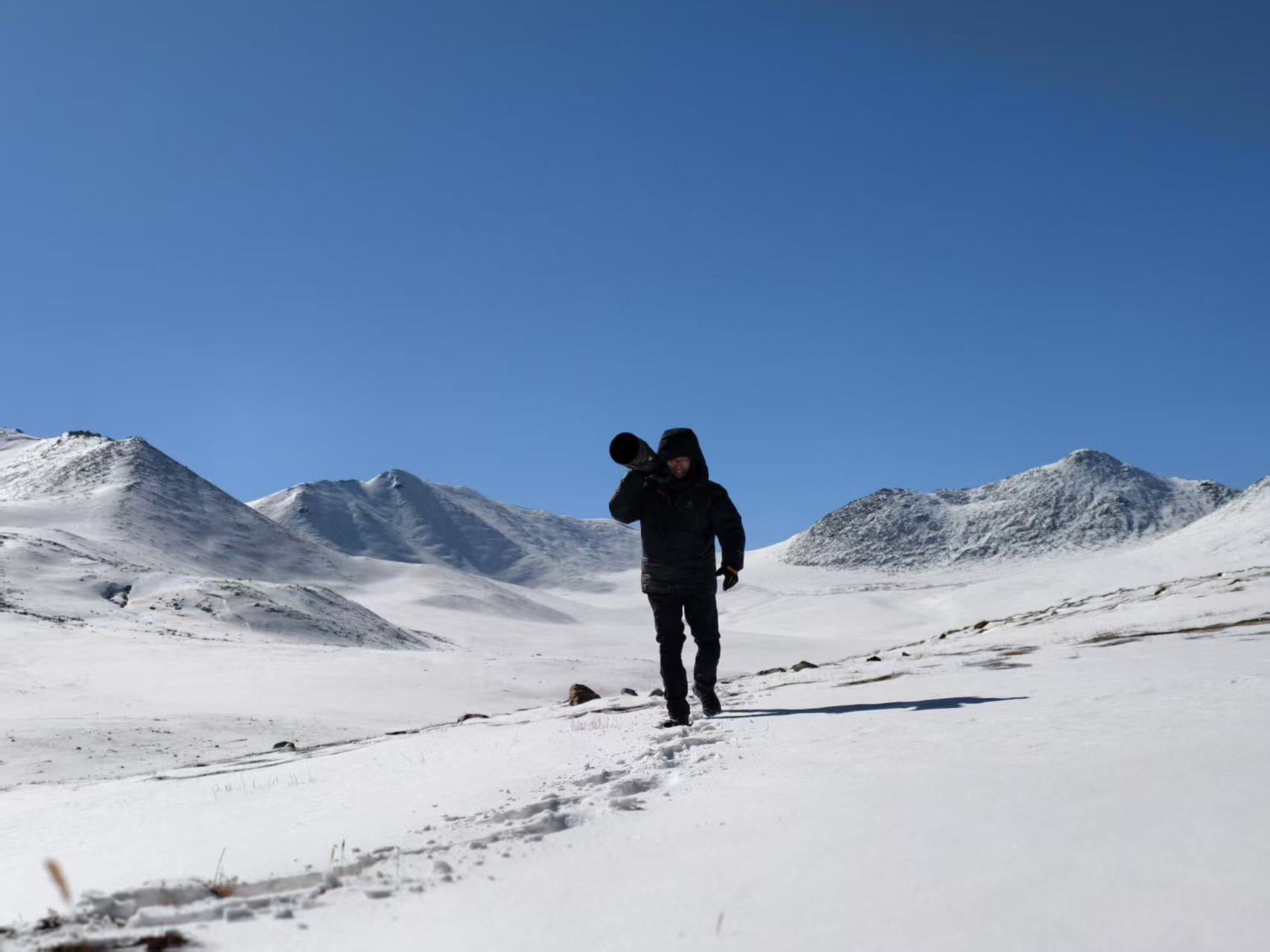
SIJI is a wildlife photographer and the founder of a digital technology company. Before dedicating himself fully to wildlife photography, he created China’s first AIGC automotive commercial and built a career in the technology industry.
His work has received major recognition, including Visual China’s Annual Best Nature Single Image and selections in National Geographic’s Annual Photography Collections. He has photographed wild snow leopards more than 100 times, often from distances of 50–100 meters.
Understanding Snow Leopard Photography
As a member of the genus Panthera, the snow leopard shares its lineage with some of the world’s most iconic big cats. Yet unlike many of its relatives, it survives in remote, high-altitude mountain landscapes, where encounters are rare and unpredictable.
Finding a snow leopard in the wild is already a remarkable achievement. Photographing one requires even more: the right conditions, the right location, patience, experience, and a deep understanding of the animal and its environment.
Why Photographing Snow Leopards Is So Challenging
Photographing a snow leopard requires overcoming several challenges, from finding the animal in vast mountain landscapes to capturing a clear image in difficult conditions.
- Rare animals in vast landscapes
With an estimated global population of only 7,446–7,996 individuals, snow leopards are among the rarest large cats in the world. Their range is limited to the high mountains of Asia, with China holding more than half of the global population and around 60% of the species’ habitat.[1] Even in the best locations, finding a snow leopard requires extensive knowledge of the landscape and wildlife patterns.
- Remote habitats and distant encounters
Snow leopards live among high-altitude cliffs and rocky terrain that are difficult for most photographers to reach. Their activity areas can extend across several to 100 square kilometers, meaning that even when a snow leopard appears, it is often visible only at a great distance.
- Exceptional camouflage and elusive behavior
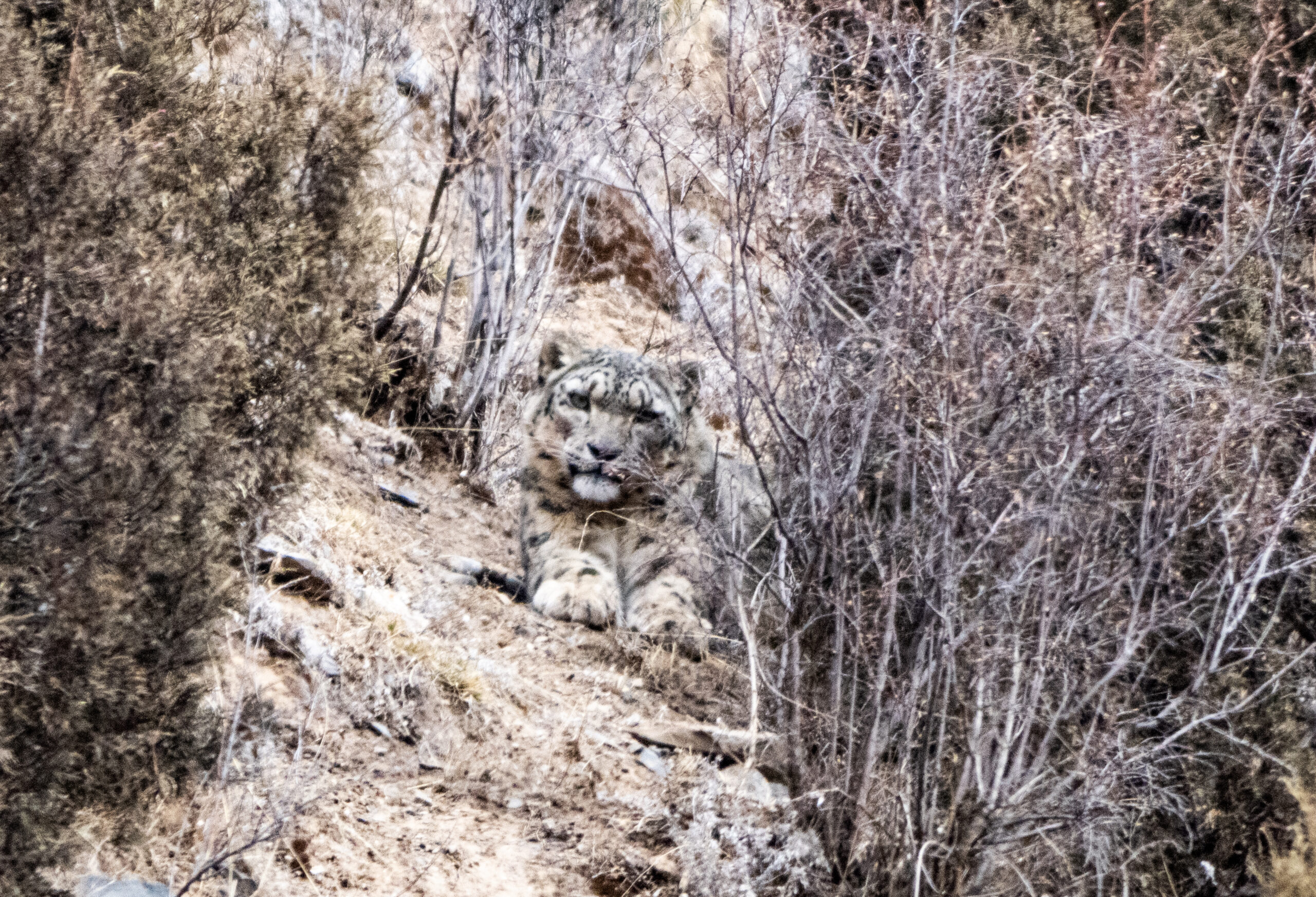
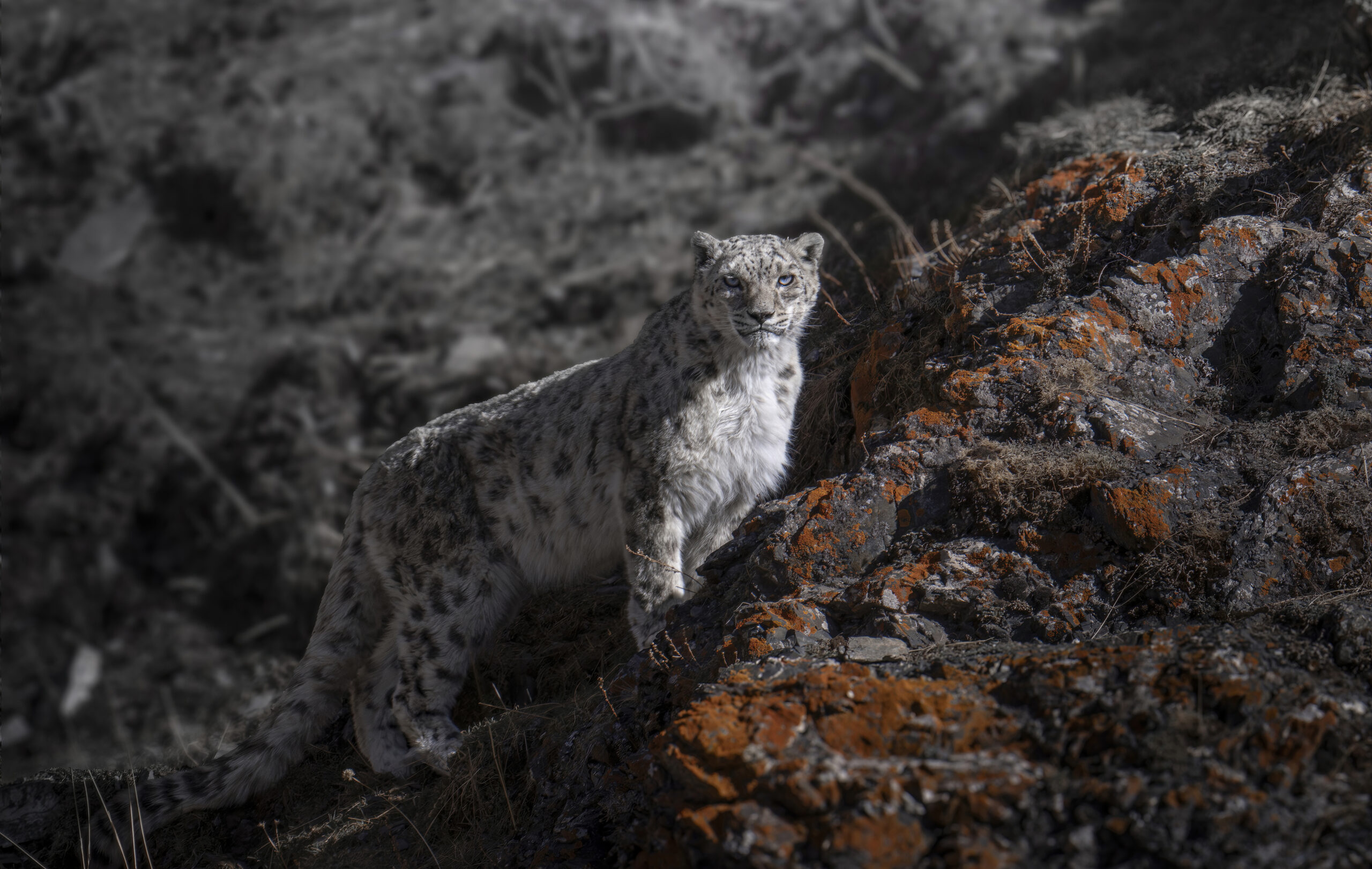
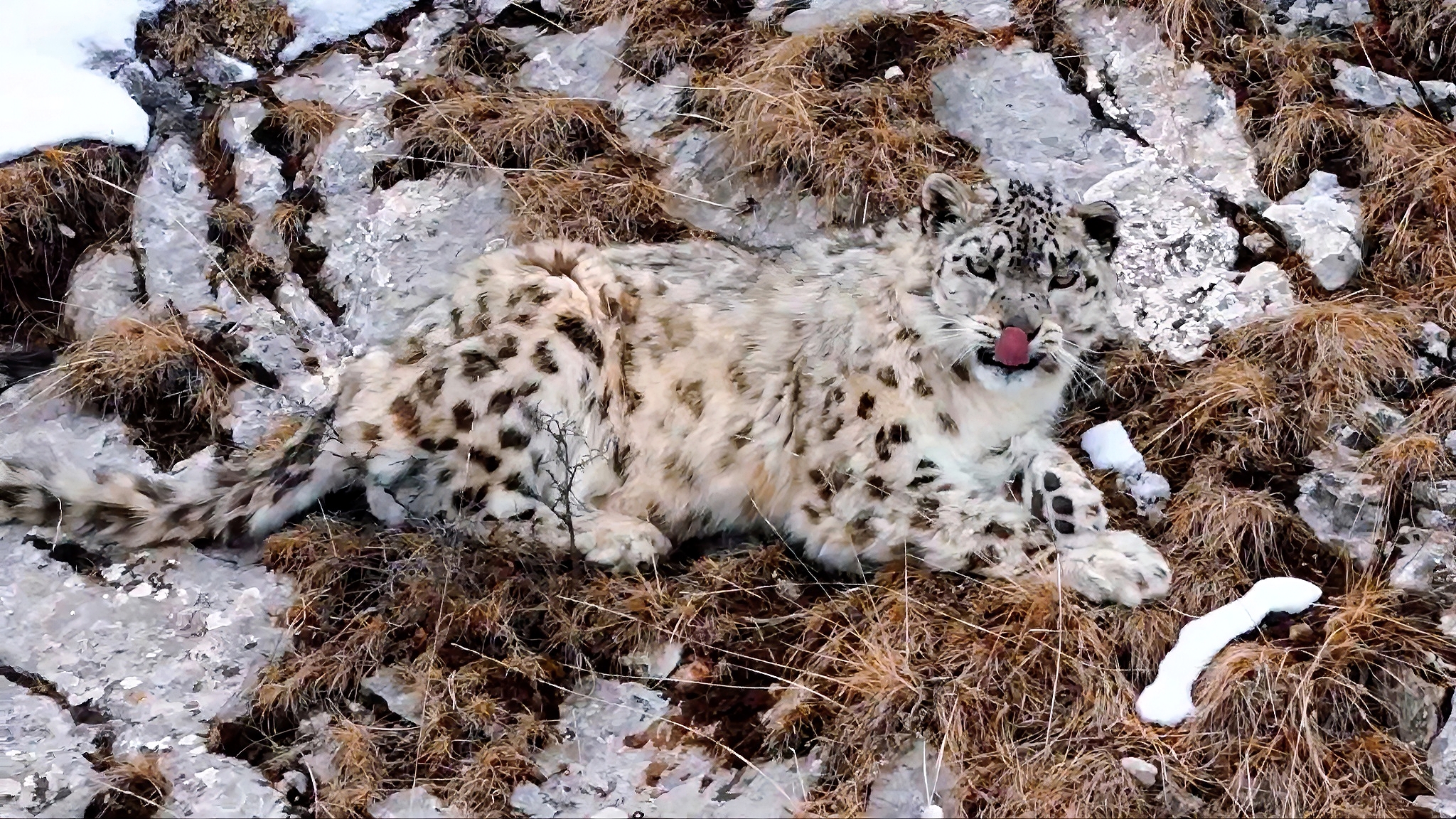
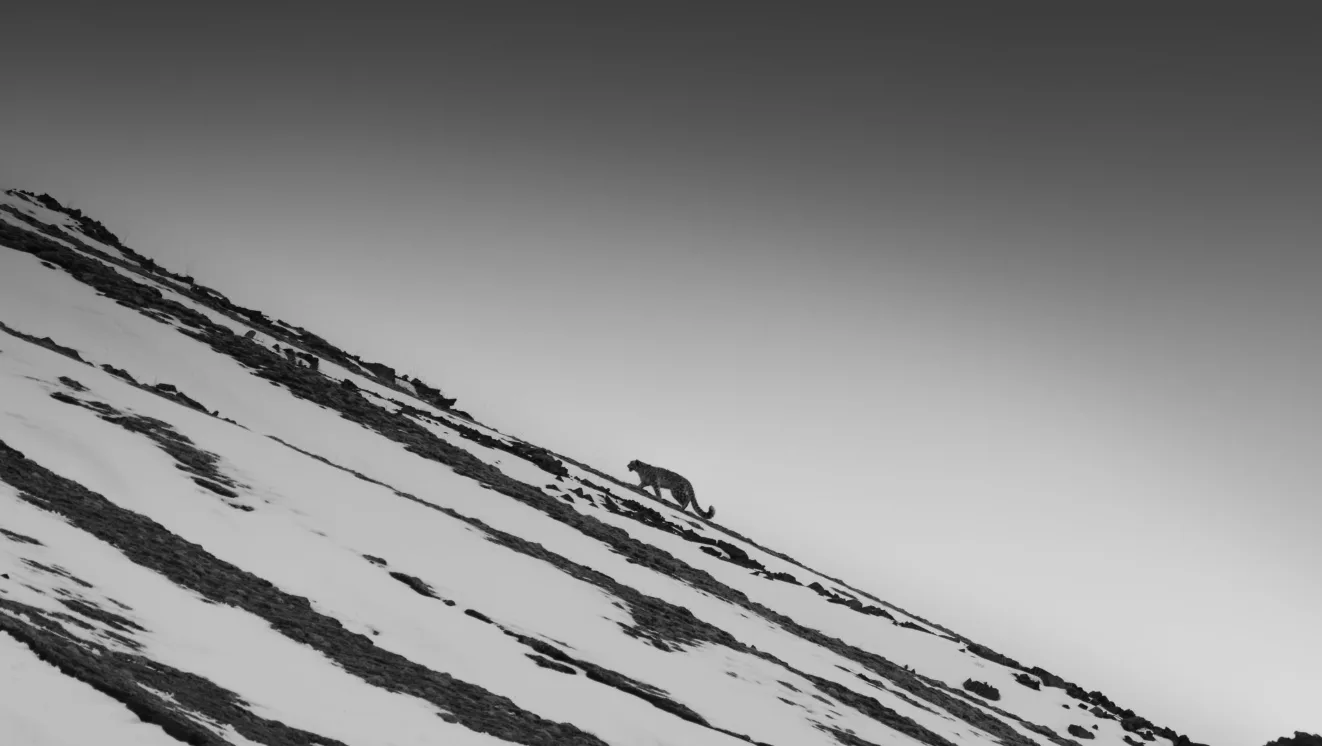
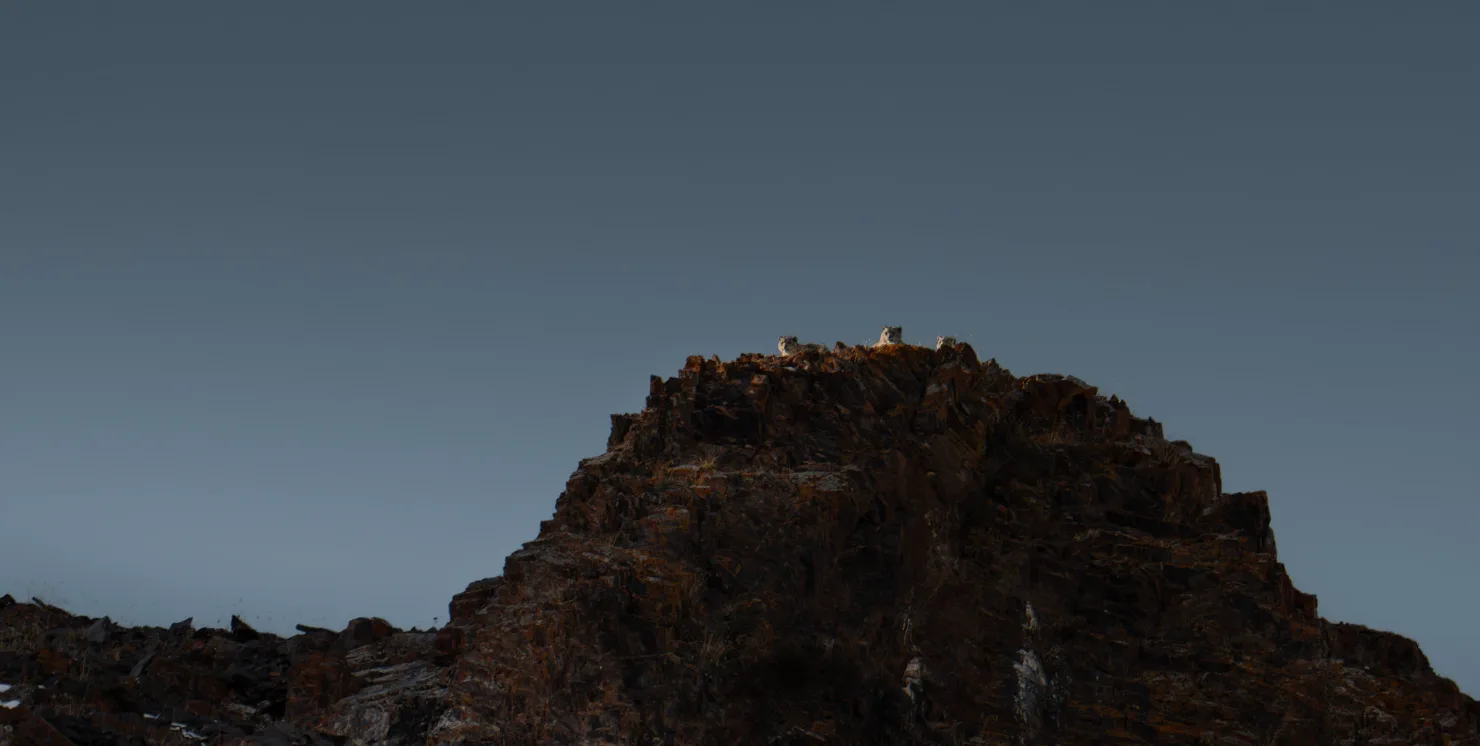
Snow leopards are naturally cautious animals and tend to avoid areas with frequent human activity. Their pale, patterned coat blends remarkably well with rocky mountain landscapes. Once a snow leopard lies still among the rocks, even experienced observers may struggle to detect it.
- Low-light photography challenges
Snow leopards are most active around dawn and dusk, when mountain light is often limited. Even a close encounter can be difficult to photograph well, requiring suitable equipment, technical skills, and patience.
How High-Altitude Landscapes Shape Your Photography
High-altitude extreme environments create unique photographic challenges. Understanding these conditions is essential when preparing for a snow leopard photography expedition.
- Harsh light and limited shooting windows
- Strong sunlight is one of the defining features of high-altitude landscapes. Around midday, light can become extremely harsh, often creating strong contrast and heat distortion that makes it difficult to achieve ideal images. The best photography opportunities are usually found after sunrise, before temperatures rise too much, and again in the late afternoon, often from around 4:30 pm to 6:00 pm.
- Wind and image stability
- Strong mountain winds can significantly affect image stability, especially when using long telephoto lenses. A stable shooting setup and careful preparation are important for capturing sharp images in exposed terrain.
With limited opportunities to photograph a snow leopard, preparation and local knowledge can make a significant difference. Experienced local guides and herders who understand the landscape and animal movements are invaluable, including in helping you choose the best vantage point for scanning slopes and ridgelines. They can recognize subtle signs of snow leopard activity, from fresh tracks and scat in the snow to vultures circling above a potential feeding site, or even the outline of a snow leopard’s head hidden among distant rocks.
Spotting the snow leopard is the first step toward capturing a successful image. Our local team organized by Eastogo holds plenty of experience for expedition.
Photographing Snow Leopards, Pallas’s Cats, and Eurasian Lynx in China (12days)
view detailCommon Observation Distances and Visibility Challenges
Snow leopard photography opportunities vary significantly between destinations. Some observation sites may have sightings only once every 7–8 days, while others may offer opportunities every 2–3 days or even daily. However, access conditions and entry policies differ between locations, so photographers should carefully evaluate each destination before planning an expedition.
- Observation Distance and Photography Opportunities
Observation distances vary between snow leopard destinations. In many locations, photographers commonly observe animals from around 1 kilometer away, while a more favorable photography distance is usually between 120 and 800 meters.
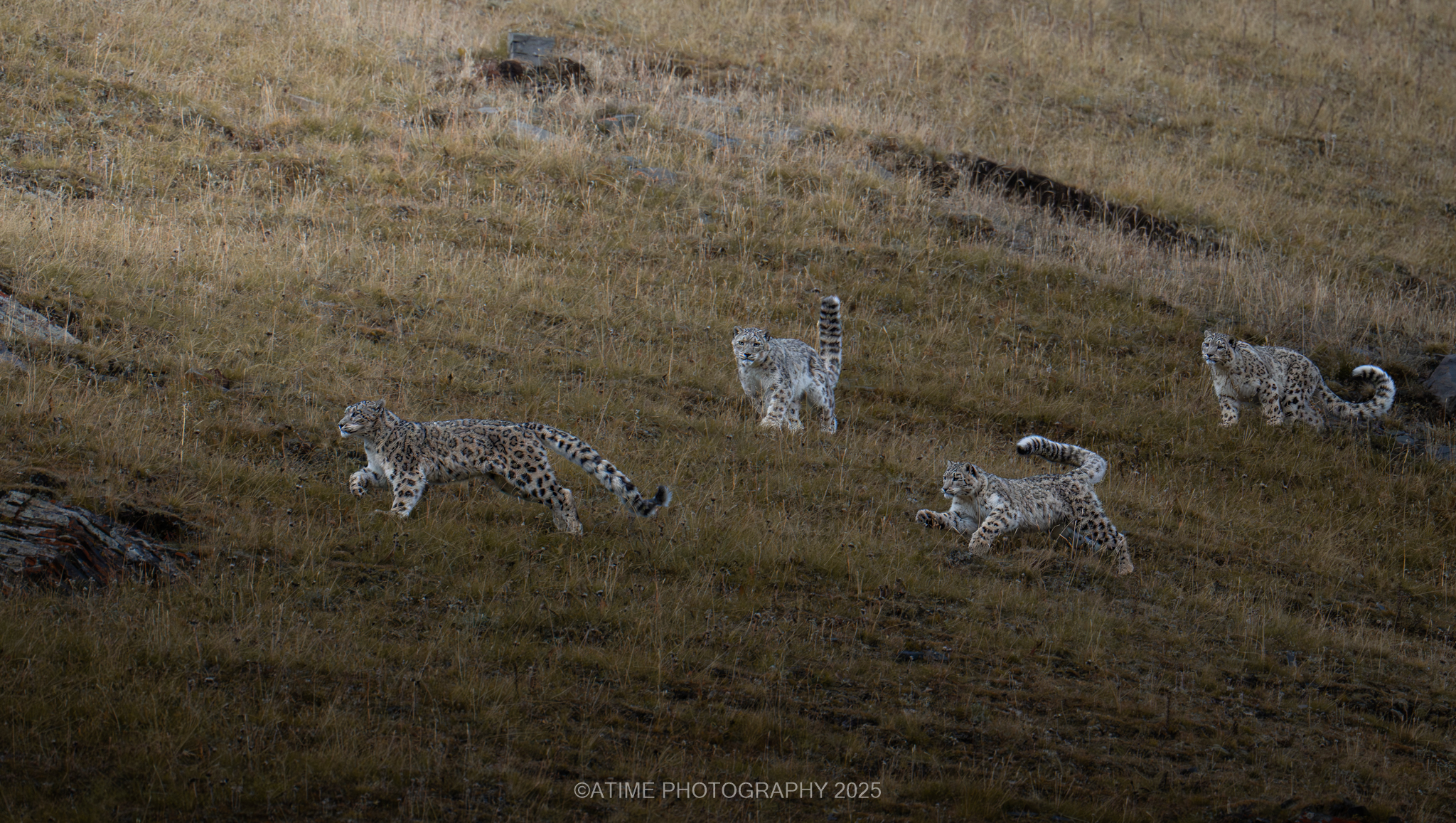
Based on field experience, snow leopard families that have lived around human activity for a long time without negative encounters may gradually become less cautious. Cubs raised in such environments can become accustomed to human presence and, in exceptional situations, may allow photographers to capture images from distances of less than 50 meters.
- Understanding Snow Leopard Behavior
Many established snow leopard destinations offer opportunities to observe relatively predictable behaviors despite the species’ elusive nature, including territorial patrols and hunting. Some individuals may conduct large-scale territorial movements approximately once a week, while hunting events may occur every 3–4 days. For family groups with more than three individuals, hunting opportunities may increase and can sometimes occur every 2–3 days.
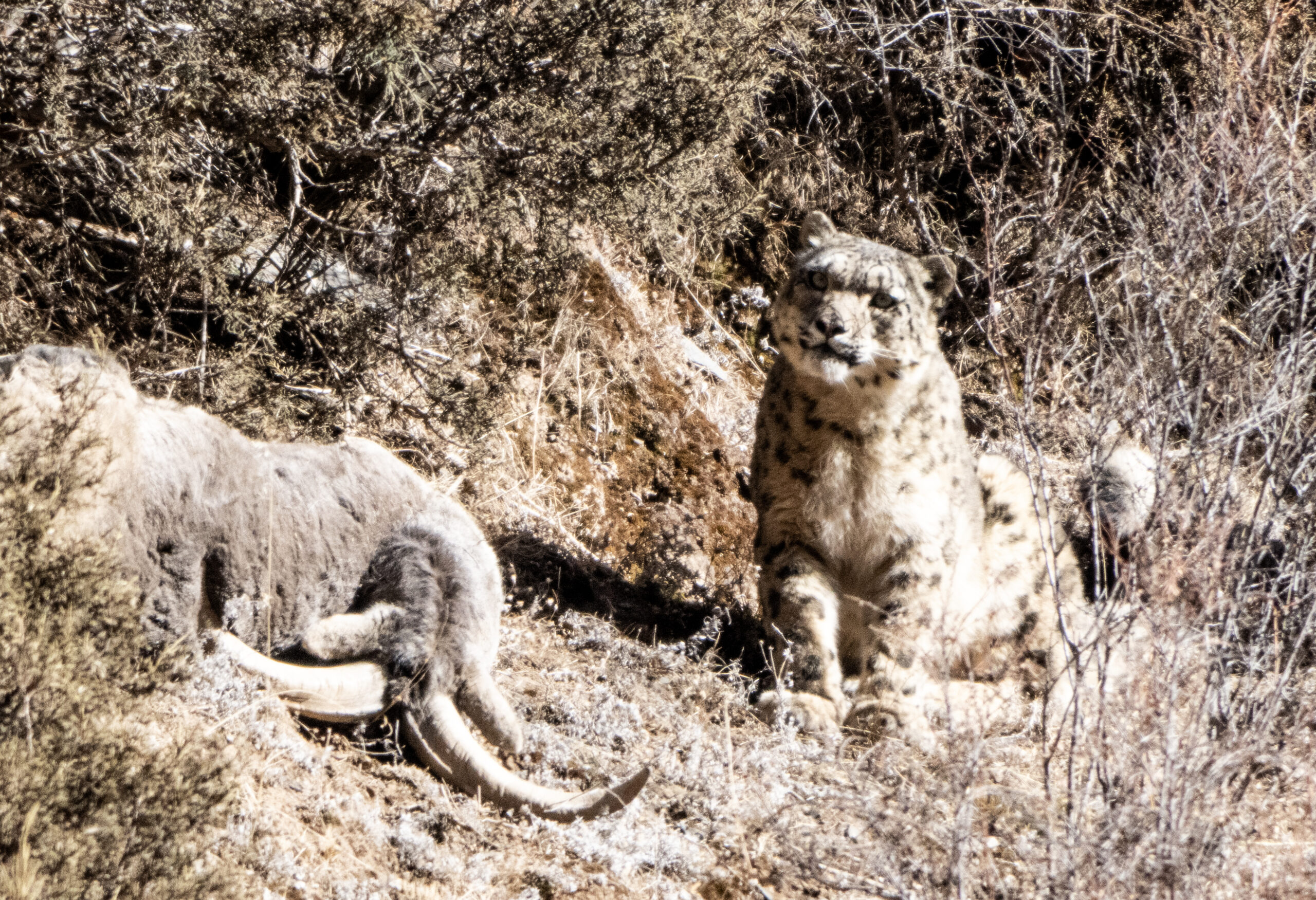
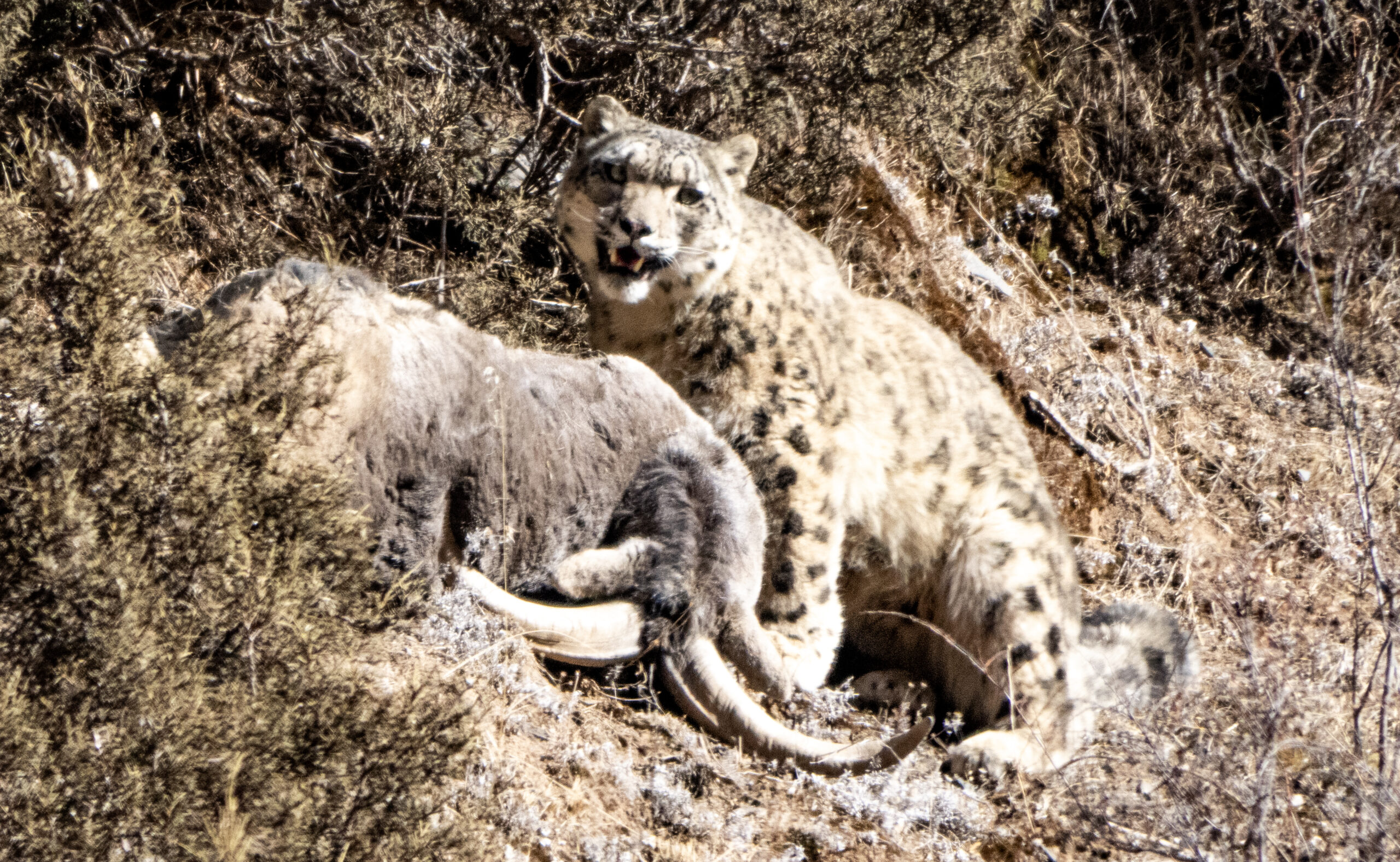
A snow leopard hunt is one of the most difficult wildlife moments to photograph—not only because it usually unfolds at night, but also because the animal’s advantage in low light makes the action nearly impossible to follow in real time. More often, the first sign of a successful hunt appears at dawn, when Himalayan vultures begin circling above a blue sheep carcass.
The opportunity is not necessarily over. If the kill remains undisturbed, the snow leopard may stay nearby and feed for hours. A hunt missed in the darkness can therefore lead to a valuable encounter the next morning, when snow leopard walking back toward the carcass can briefly become visible and the light is finally workable for photography.
Camera Equipment for Photographing Snow Leopards
- Choosing a Camera Body for Wildlife Photography
Snow leopard photography places high demands on autofocus performance and continuous shooting speed. Most major camera brands now offer professional bodies designed for wildlife photography.
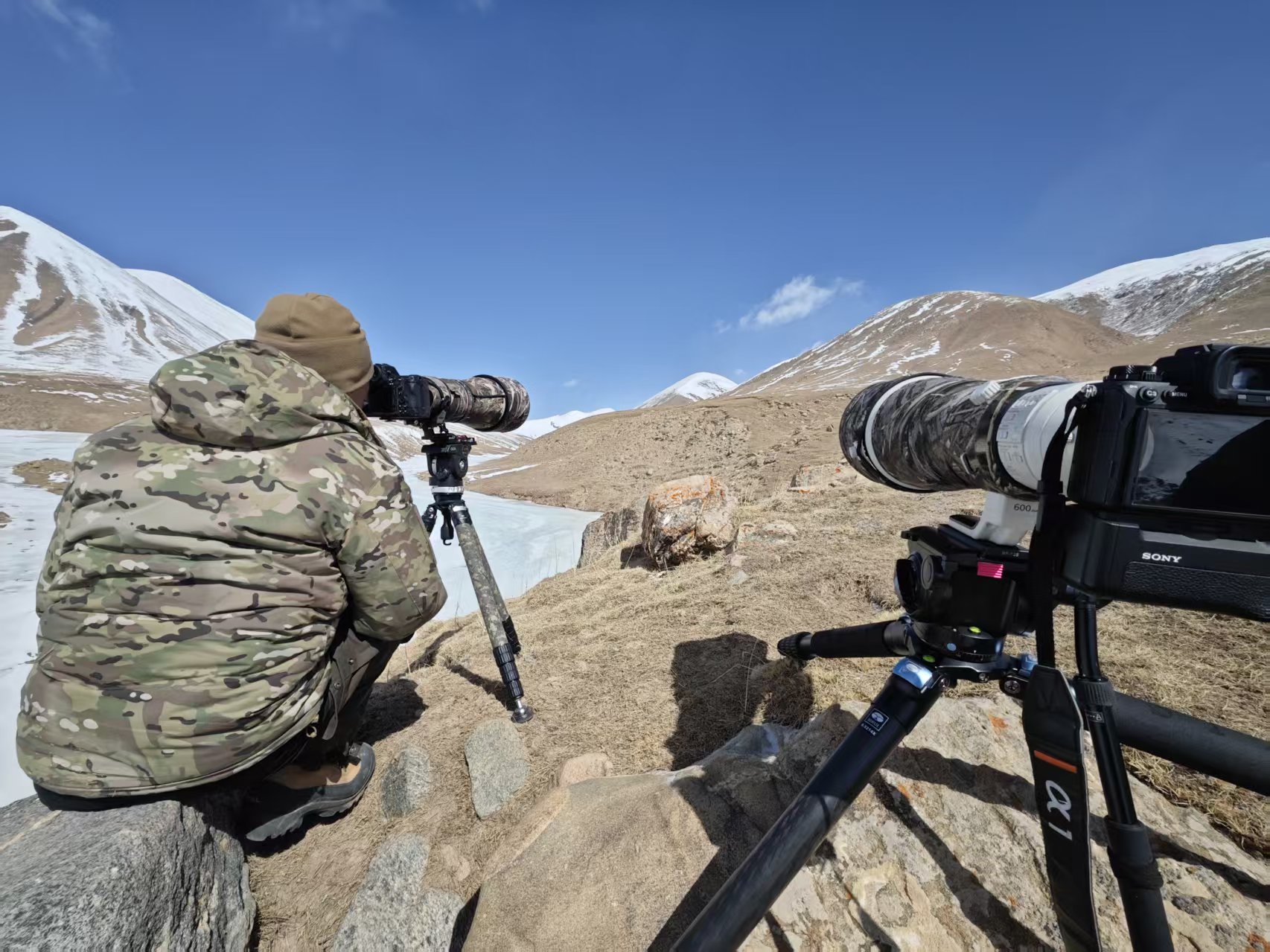
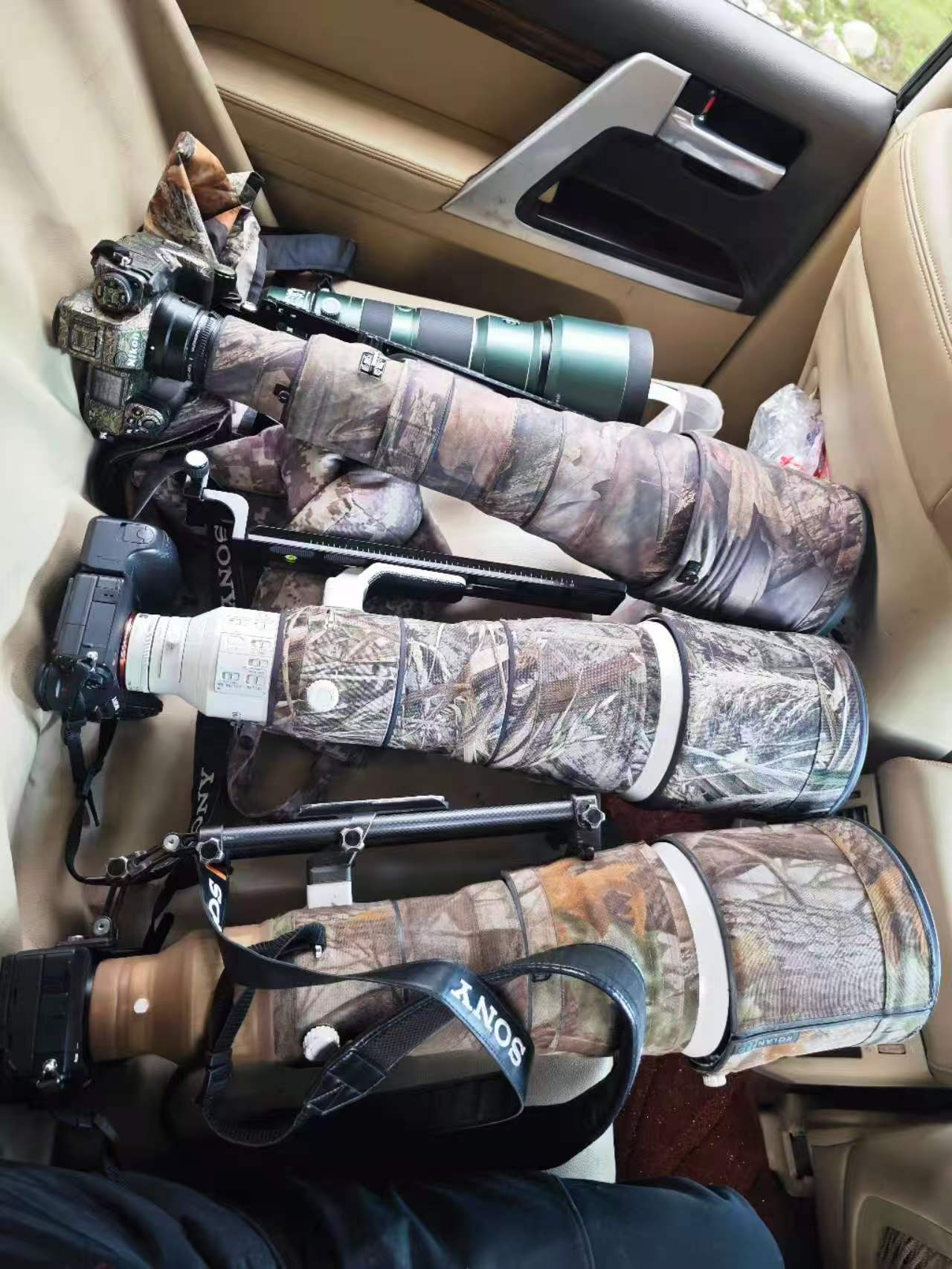
For Sony, the two camera bodies I am most familiar with are the Sony Alpha 1 (A1) and Alpha 9 (A9) series. The A1 combines high resolution with high-speed performance, while the A9 series focuses more on speed with slightly lower resolution.
For Nikon, I would recommend the Z9 series, while Canon offers the EOS R1 series. Both are designed for demanding wildlife photography, with fast performance and high-resolution image capture.
- Best Telephoto Lenses for Snow Leopard Photography
Snow leopards present a unique challenge for photographers: they are often far away, appear briefly, and are frequently found in low-light conditions. A long telephoto lens with the widest possible aperture is therefore essential.
- Sony: 600mm f/4 prime lens. Because Sony’s native super-telephoto options provide less reach for some situations, many photographers combine it with a 1.4× teleconverter.
- Nikon: 800mm f/5.6 prime lens.
- Canon: 800mm f/5.6 prime lens, with another option being the 1200mm f/8 prime lens for photographers who need additional reach.
- Teleconverters: When to Use Them and Their Trade-offs
A teleconverter is an essential tool for snow leopard photography. In most situations, snow leopards remain at considerable distances, and a suitable teleconverter can provide the additional reach needed to capture more detailed images.
However, teleconverters also affect both aperture and image quality. For this reason, a 1.4× teleconverter is usually preferred over a 2× teleconverter, as it provides extra reach while reducing the impact on image quality. When a snow leopard happens to approach much closer, it is often better to remove the teleconverter and photograph with the lens directly.
- Tripods and Gimbal Heads
For tripod and gimbal combinations, my personal recommendation is a Sachtler gimbal head paired with a Gitzo tripod. In my experience, this combination provides one of the best setups for snow leopard photography, although it is also a significant investment.
Spare Batteries
High-altitude snow leopard photography often takes place in extremely cold conditions. Temperatures can drop below -20°C, while morning and evening shooting periods are commonly around 0°C to -10°C.
I recommend carrying at least four spare batteries and keeping them inside the inner pocket of a down jacket or another warm layer. Cold temperatures can significantly reduce battery performance, and keeping batteries warm helps ensure they remain reliable throughout long observation periods.
Supplementary Lenses and Photography Kits
- Landscape, Camp, and Cultural Photography: 24–70mm and 70–200mm
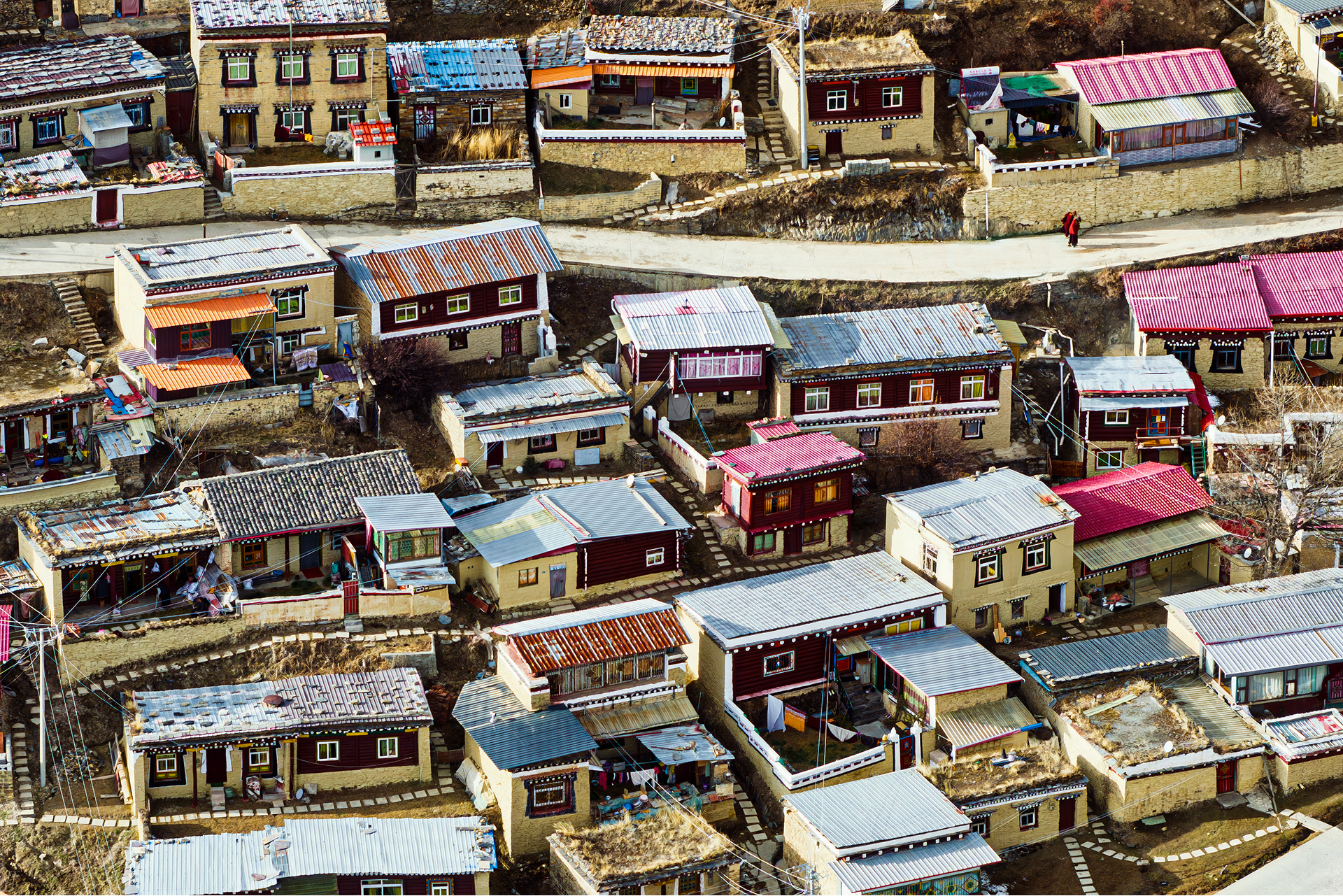
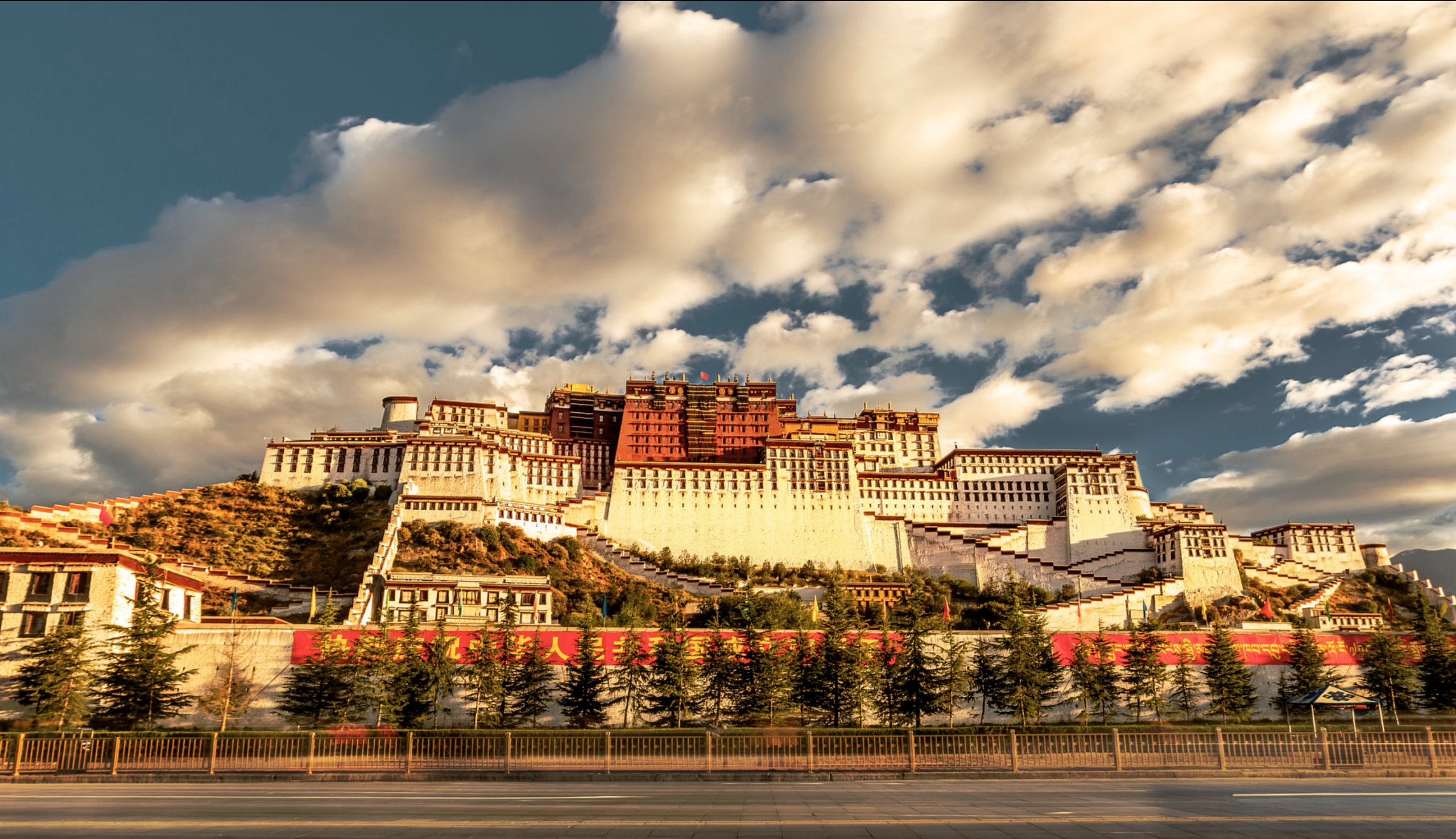
A 24–70mm standard zoom lens is usually enough for photographing high-altitude landscapes, landscape photography in camp surroundings, village life, and environmental portraits. If cultural photography is also an important part of the expedition, adding a 70–200mm wide-aperture lens can be useful for capturing people’s expressions, prayer flags, and details from a greater distance in places shaped by Tibetan Buddhism.
I use this focal range across all my camera systems, and the Sony 70–200mm is one of my go-to lenses for photographing local people and everyday life. Unless you plan to shoot the Milky Way or expansive night-sky scenes, there is usually no need to add an ultra-wide-angle lens.
When photographing local herders and their family life, always ask for permission from the person being photographed or your local guide beforehand.
- Backup Wildlife Zoom Lens: Prioritize Reach
In open plateau landscapes, wildlife is often found at considerable distances, so 200–300mm lenses are rarely the primary choice. For photographing Tibetan foxes, wolves, and other distant wildlife, a zoom lens reaching 600mm or beyond is usually more practical.
Recommended options include:
- Sony: 200–600mm
- Nikon: 180–600mm
- Canon: 200–800mm
Snow Leopard Photography Camera Settings
Snow leopard photography requires quick adjustments because different behaviors demand different combinations of aperture and shutter speed. Understanding your camera and being able to react instinctively in the field is often more important than relying on fixed settings.
Below are my usual settings for some common snow leopard behaviors:
- Resting on rocks
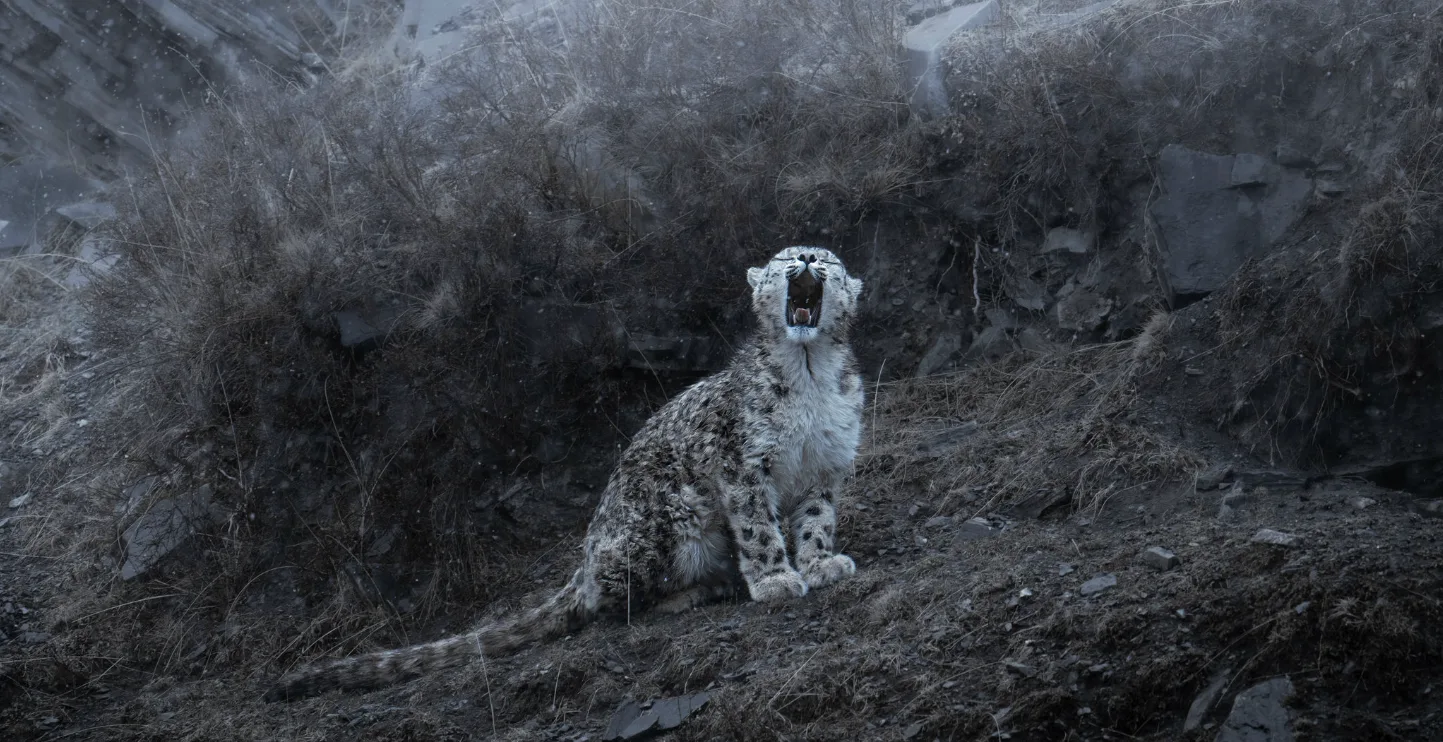
This is the most common situation. When a snow leopard is completely still, I usually lower the shutter speed to improve image quality. In some cases, I may use speeds as slow as 1/125 sec. If snow is falling and the animal remains still, I may even reduce it to around 1/50 sec. However, there is always a risk of slight motion blur if the snow leopard moves unexpectedly.
- Walking and patrolling its territory
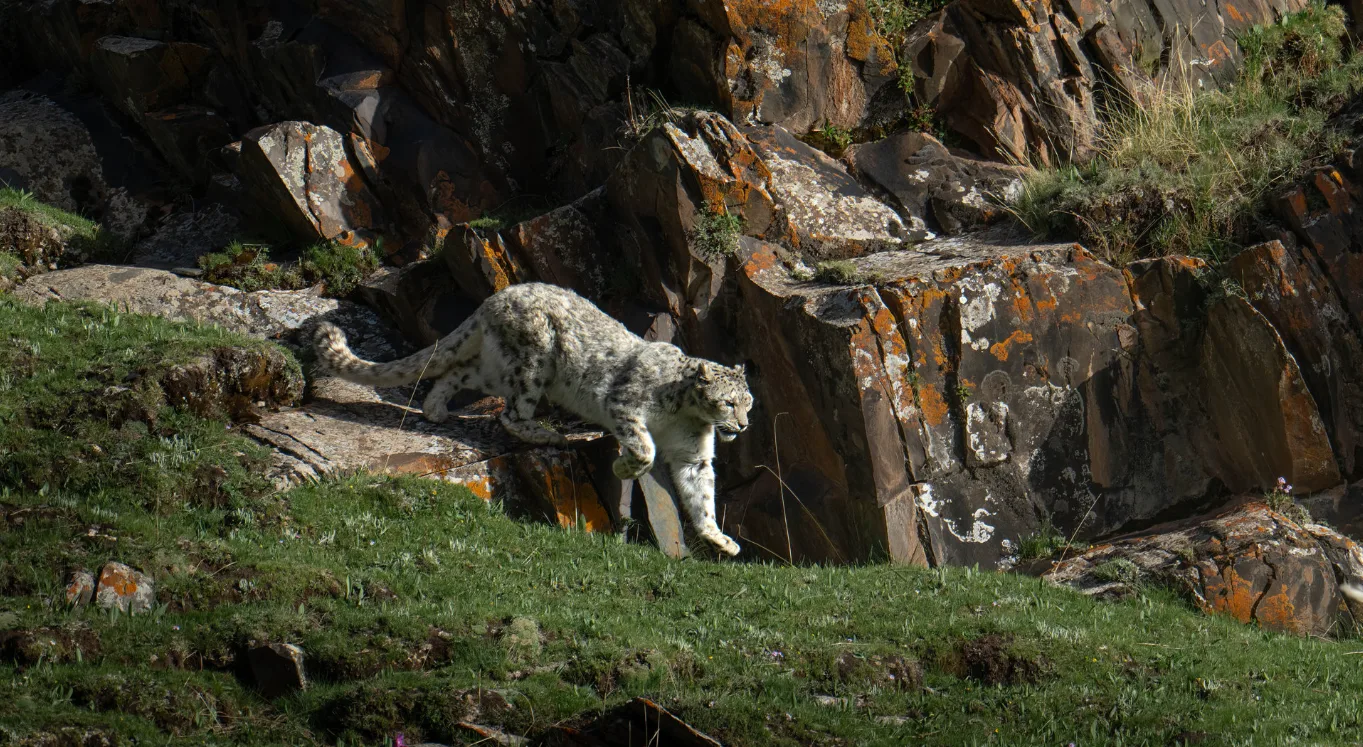
When a snow leopard is moving slowly while patrolling its territory, I usually increase the shutter speed to around 1/800 sec. If the animal begins walking faster, I may raise it to around 1/1000 sec.
- Playing, fighting, or preparing to hunt
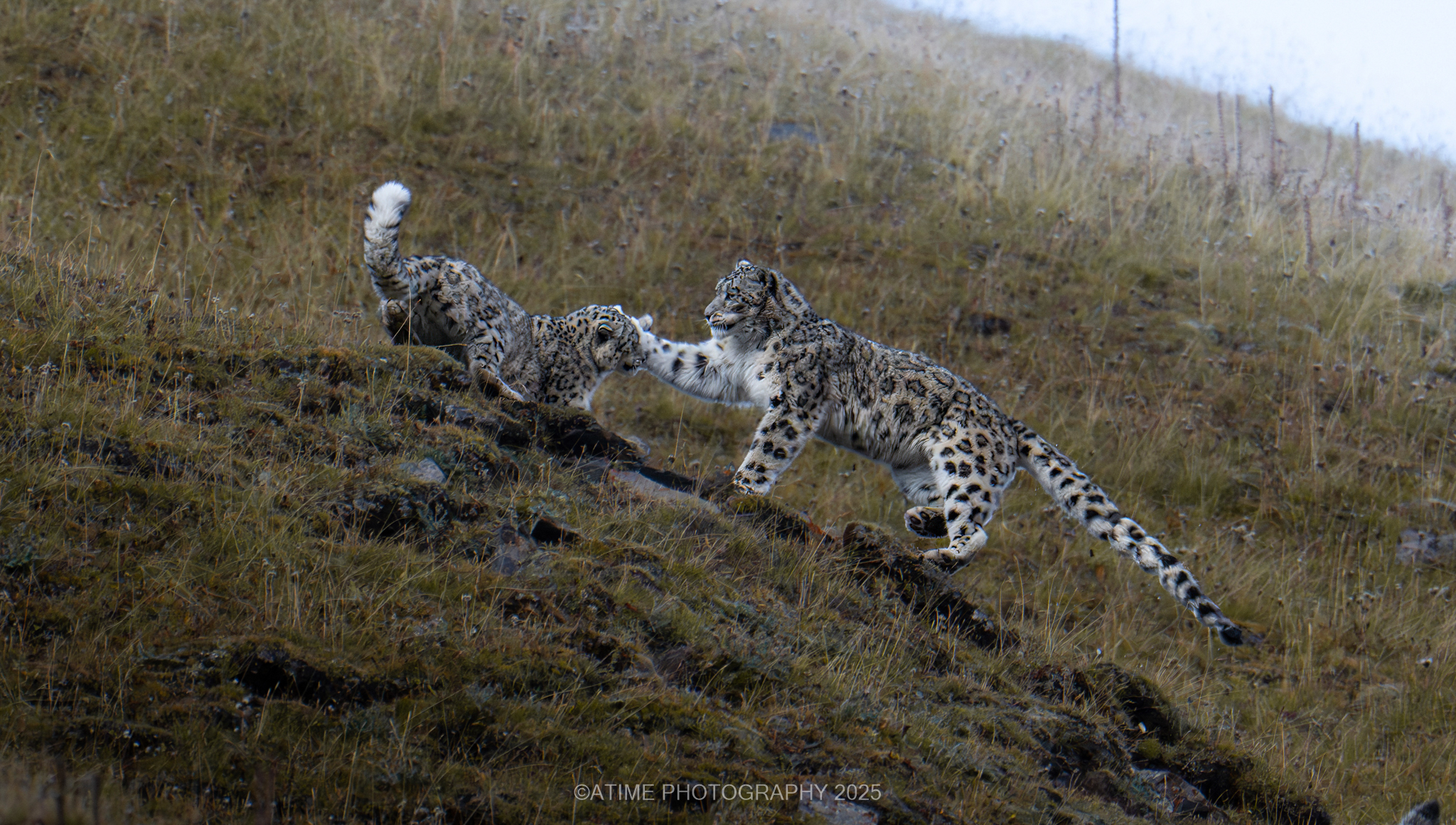
Once a snow leopard begins moving quickly, faster shutter speeds become essential. For active behaviors such as playing, fighting, or preparing for a hunt, I generally use at least 1/1250 sec. If a snow leopard begins hunting blue sheep, I increase the speed to 1/1600 sec or faster. When the animal comes within around 100 meters, I may push the shutter speed beyond 1/2000 sec to ensure sharp images.
For these situations, I usually recommend setting ISO to Auto, allowing the camera to adapt quickly as light conditions change.
There are also unpredictable moments in the field where experience matters more than any preset. Once, a snow leopard appeared unexpectedly just before sunset in extremely low light. To capture a usable image, I had to push the ISO to 40,000. In real snow leopard photography, the best settings are ultimately learned through experience and adapting to the moment.
- Autofocus Modes and Back-Button Focus Settings
For snow leopard photography, I recommend using single-point autofocus with continuous autofocus mode. This setup provides more precise focus control while allowing quick reactions when the animal changes position.
- Burst Shooting Strategies and Battery Management
For burst shooting, I usually use high-speed continuous shooting at 20 frames per second. In situations with extremely fast movement, such as a snow leopard hunt, I may increase this to 30 frames per second to capture key moments.
For battery management, I recommend prioritizing performance settings. In wildlife photography, maintaining the fastest autofocus response is more important than saving battery power during a rare encounter.
If you’d like to join me in photographing snow leopards, Pallas’s cats, and Eurasian lynxes at one of China’s best wildlife photography locations, you can take a look at our 12-day photopraphing of snow leopard tour.
Composition Techniques for Snow Leopard Photography
- Using Negative Space to Show Scale
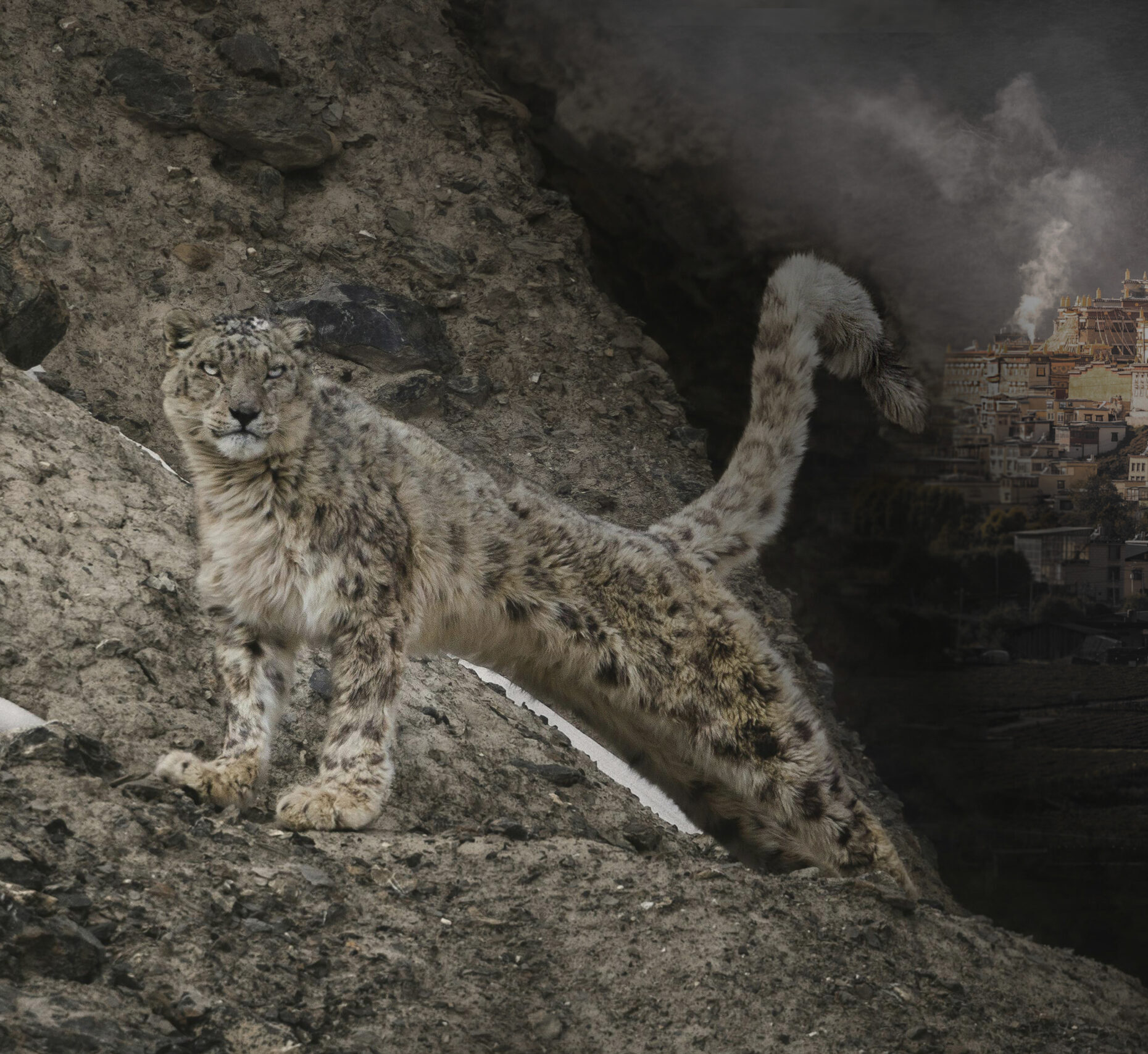
The ideal snow leopard portrait is a close view of the animal with dramatic mountain scenery in the background. A snow leopard standing against a vast mountain landscape can create one of the best photographic opportunities for showing scale.
However, this type of image is extremely rare. In most situations, simply finding and photographing a snow leopard in the wild is already a significant achievement. The perfect combination of animal position, distance, and landscape requires patience and a great deal of luck.
- Creating Environmental Portraits on the Tibetan Plateau
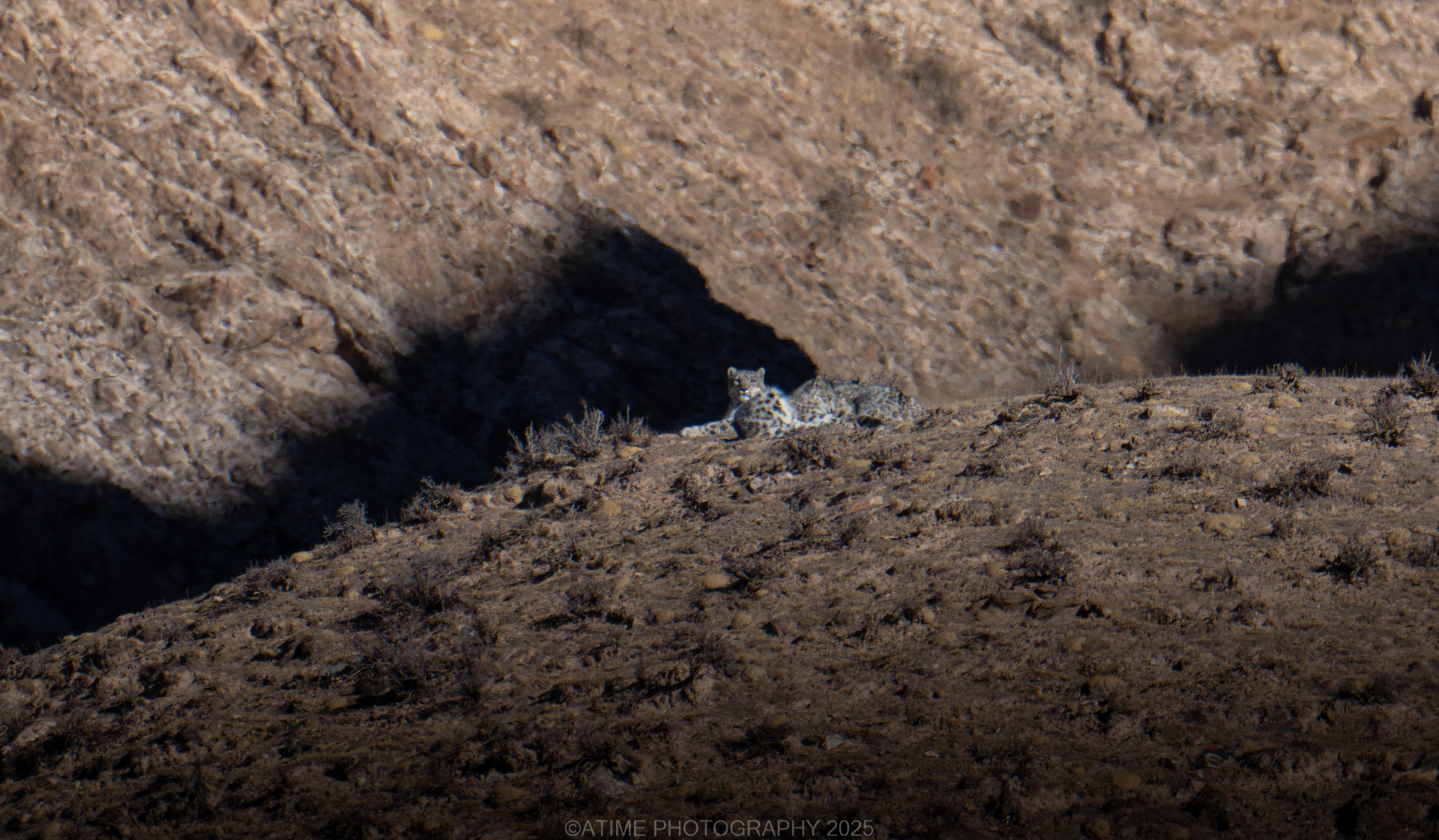
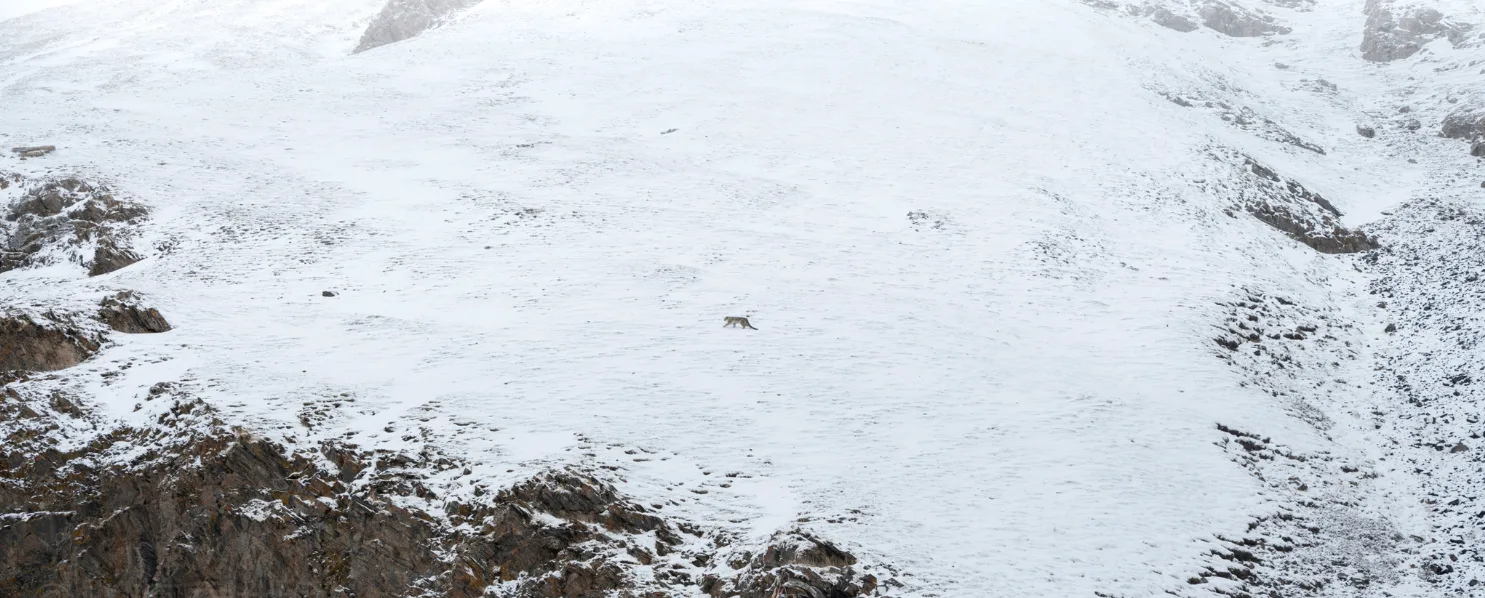
For wildlife photography, showing the relationship between an animal and its environment in its natural habitat can often create a more powerful image than a simple close-up portrait. When a snow leopard appears at medium or long distances, photographers should consider the entire landscape, including mountain shapes, ridgelines, and surrounding terrain.
These environmental compositions can transform a small subject in the frame into a powerful story about survival in the high mountains. This style of image is also highly valued in natural history photography and represents the kind of environmental storytelling often appreciated by publications such as National Geographic, especially when fantastic scenery strengthens the sense of place.
- Using Rim Light and Backlight at Sunrise and Sunset
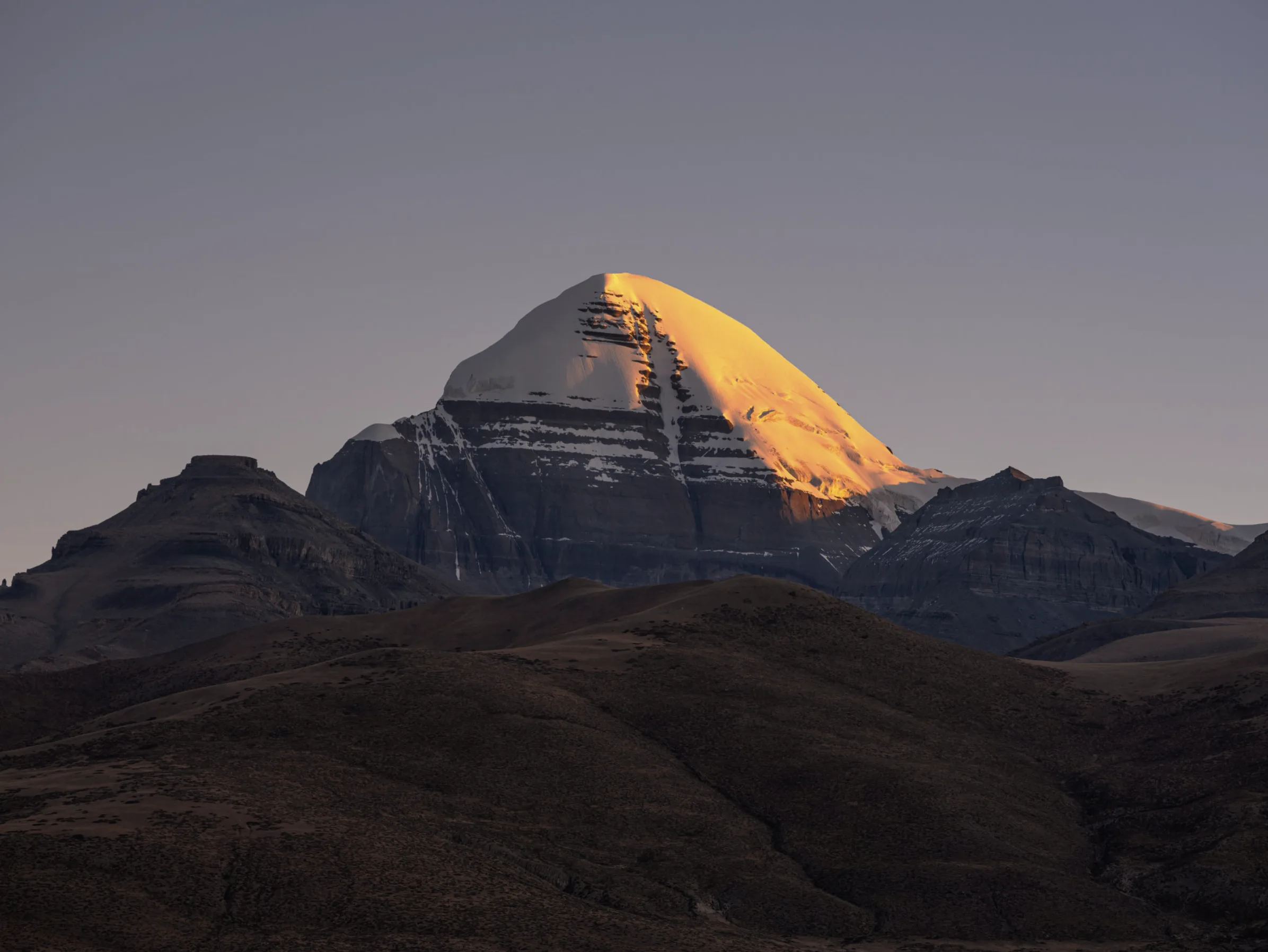
A snow leopard photographed with dramatic rim light or backlight is one of the most sought-after images among wildlife photographers. However, these conditions are extremely difficult to achieve in high-altitude mountain environments.
Unlike open African savannas, where sunlight often travels across wide, unobstructed landscapes, mountain terrain frequently blocks low-angle light around sunrise and sunset. A perfect backlit image may only happen when a snow leopard happens to stand on an exposed ridge or rocky peak, with direct sunlight reaching the animal without obstruction.
These moments cannot be planned completely. They depend on timing, location, and ultimately, luck.
Photographing Blue Sheep and Other Wildlife Behavior
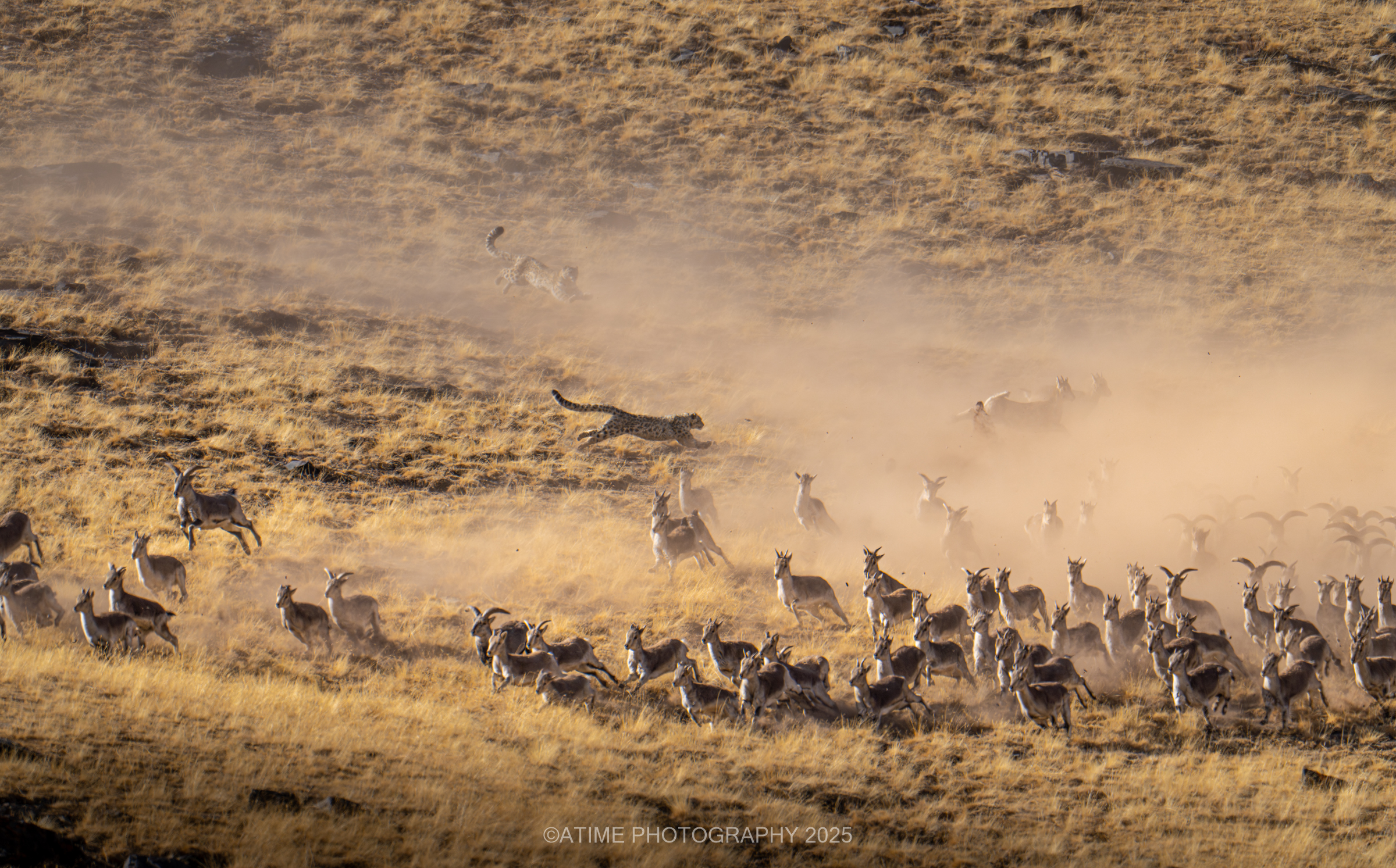
How to Photograph a Snow Leopard Hunting Blue Sheep
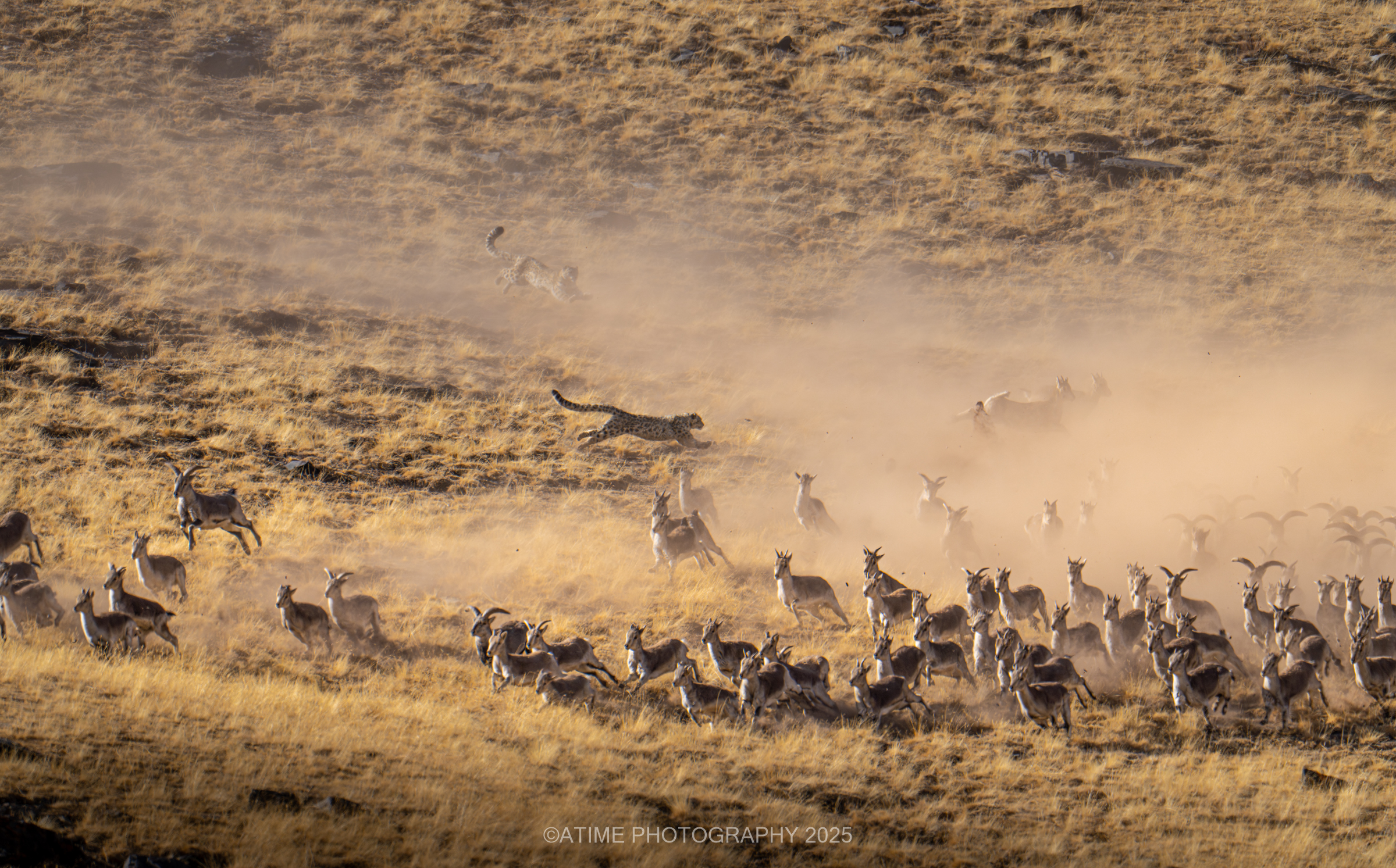
A snow leopard hunting blue sheep is one of the most challenging and rewarding moments a wildlife photographer can capture. The difficulty is not only the speed of the action, but also recognizing the signs before the attack begins.
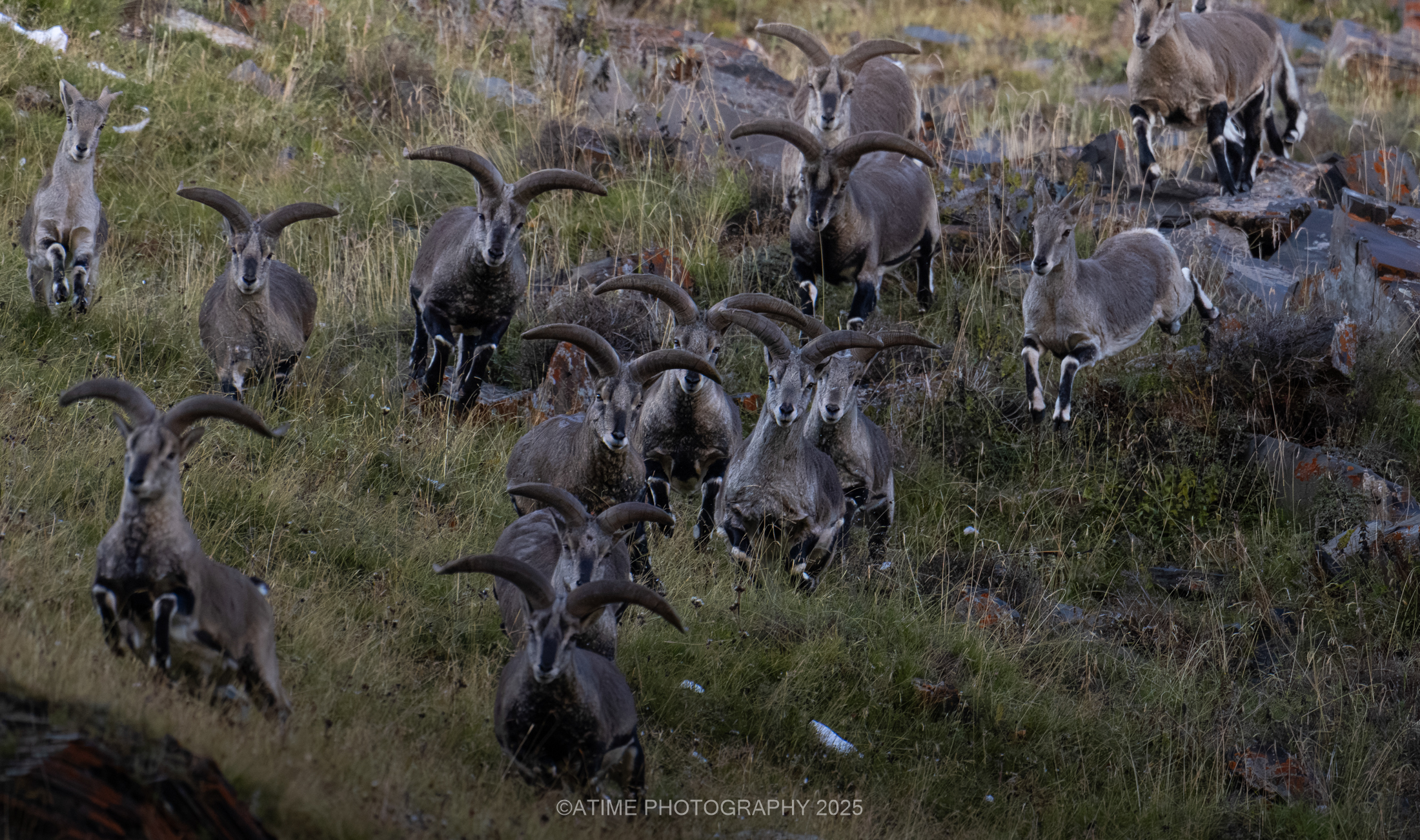
Blue sheep often reveal that something is wrong before the snow leopard becomes visible. As with many prey animals, when an entire group suddenly stops feeding and turns their attention toward the same direction, it is usually a strong indication that a predator is nearby. From my experience, once blue sheep have detected the threat and started running, a lone snow leopard rarely has a realistic chance of catching them.
Snow leopards typically rely on two hunting strategies.
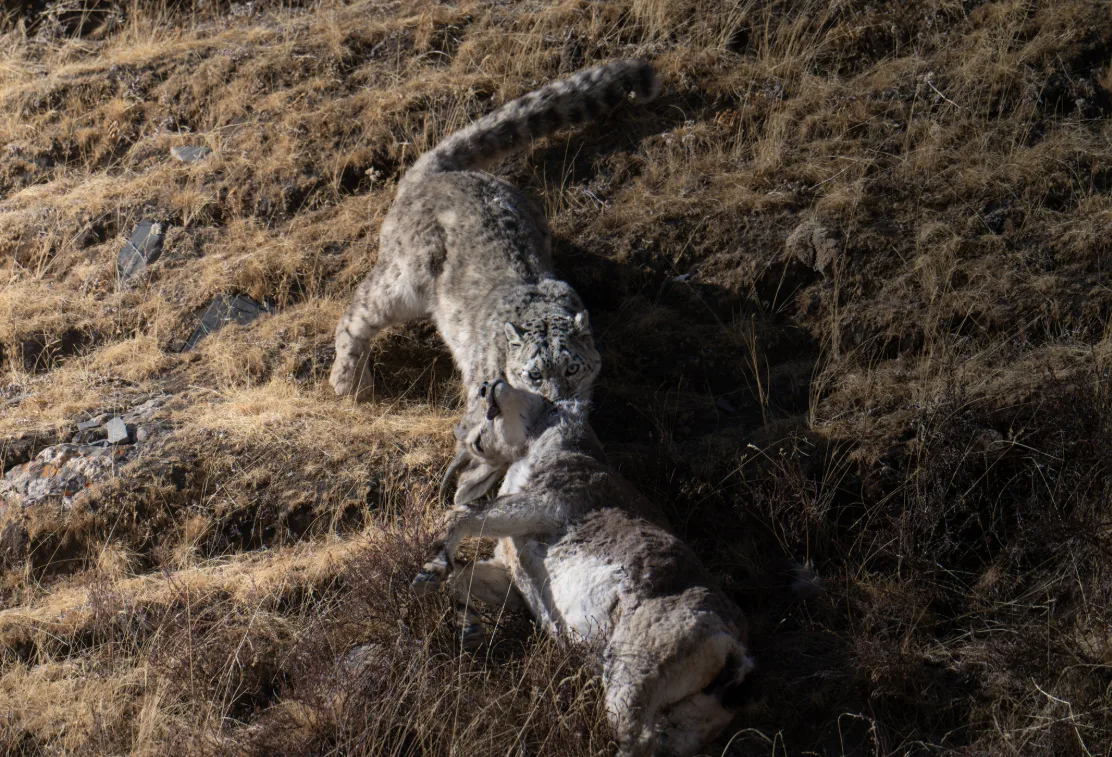
The first is a stealth attack. The snow leopard lowers its body, moves slowly through the rocks, and uses the terrain to stay hidden. It usually positions itself above the prey before launching a sudden attack. When you see this low, focused posture, the hunt has already begun. One detail worth watching is the tail: just before the charge, the tip often starts moving rapidly from side to side.
The second strategy appears when snow leopards hunt as a family group. Two or three individuals may approach from different directions, working together to control the movement of the blue sheep. The first snow leopard to move is not necessarily the one making the final attack. Its role may be to push the prey toward the more experienced hunter within the group.
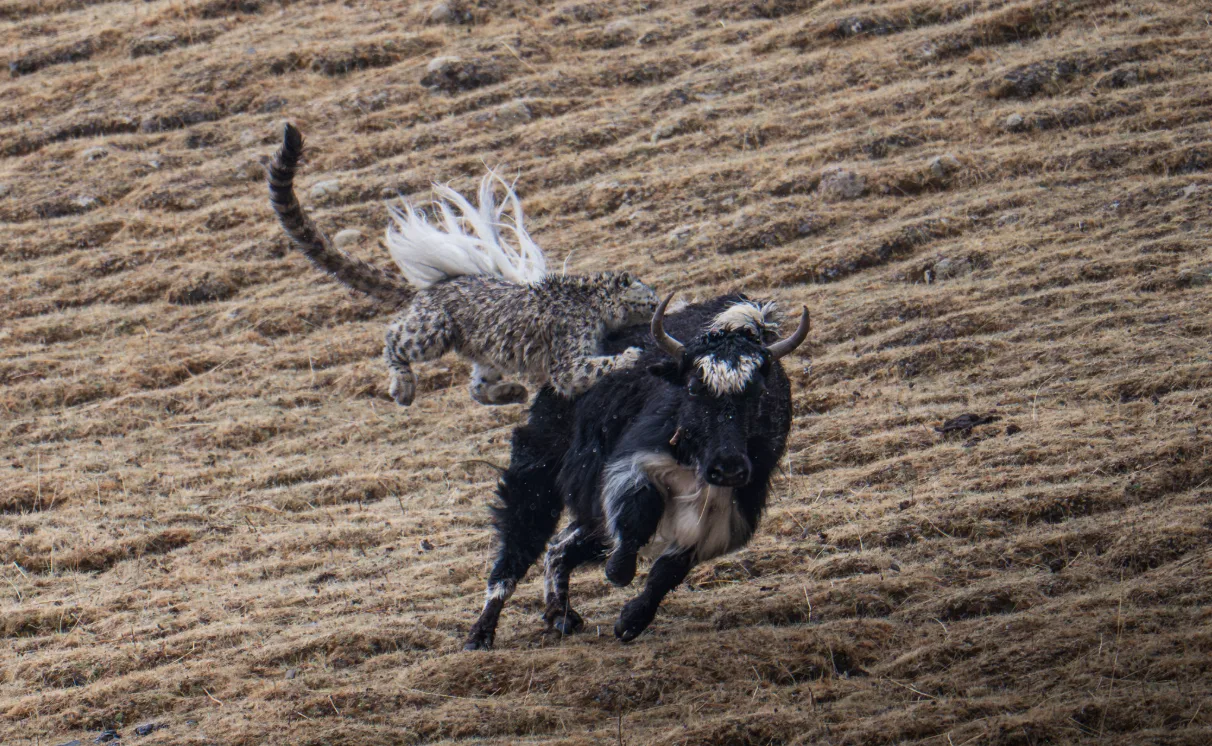
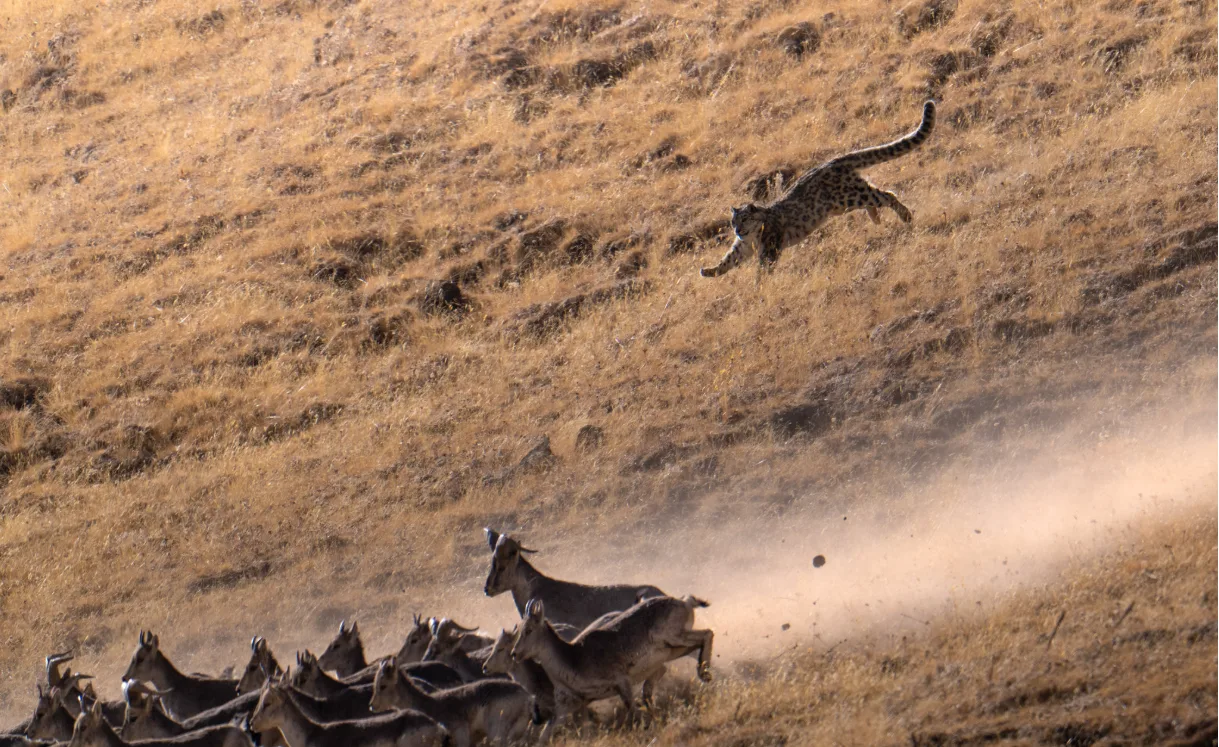
There are two common approaches when photographing a snow leopard hunting blue sheep.
- Keep the camera on the snow leopard itself. Using single-point autofocus, the photographer continuously tracks the animal as it moves.
- Used when only the blue sheep are visible and the snow leopard remains hidden. In this situation, the photographer follows the prey instead, waiting for the moment when the blue sheep suddenly begin to run and the snow leopard emerges from behind the rocks.
Blue sheep are rarely found alone. Groups usually include several individuals, and sometimes dozens or even hundreds, and snow leopards in other area also hunt other wild sheep, including Tibetan Argali, the world’s largest wild sheep. When a snow leopard launches an attack, the goal is not only to capture the predator, but to include both the snow leopard and the blue sheep in the frame to show the interaction.
During a chase, keep the focus following the snow leopard whenever possible. If dust, rocks, or terrain temporarily block the animal, shift focus to the last few blue sheep in the group. In many cases, the snow leopard will appear again within seconds.
Photographing Other Plateau Species In Snow Leopard Habitat
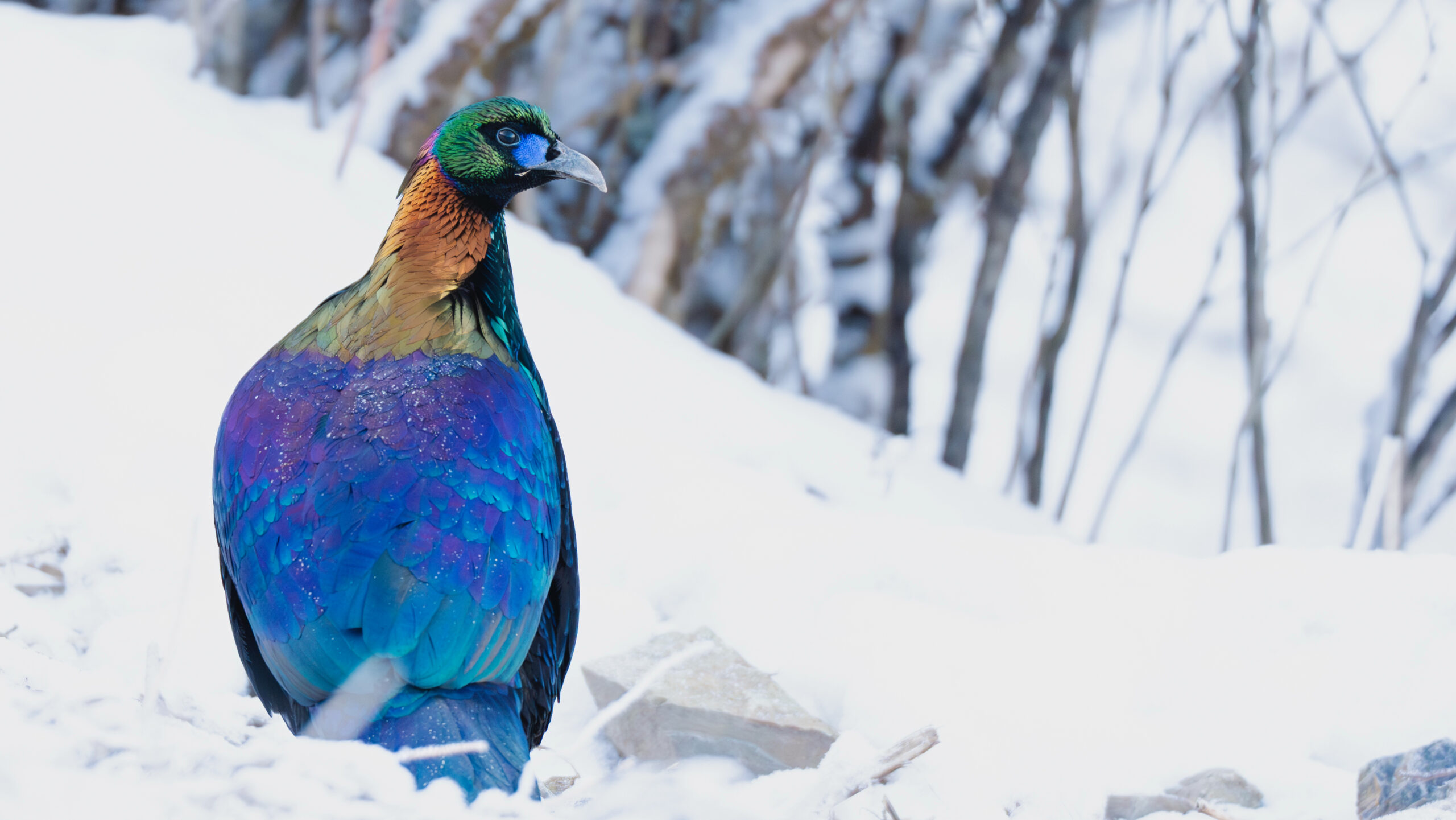
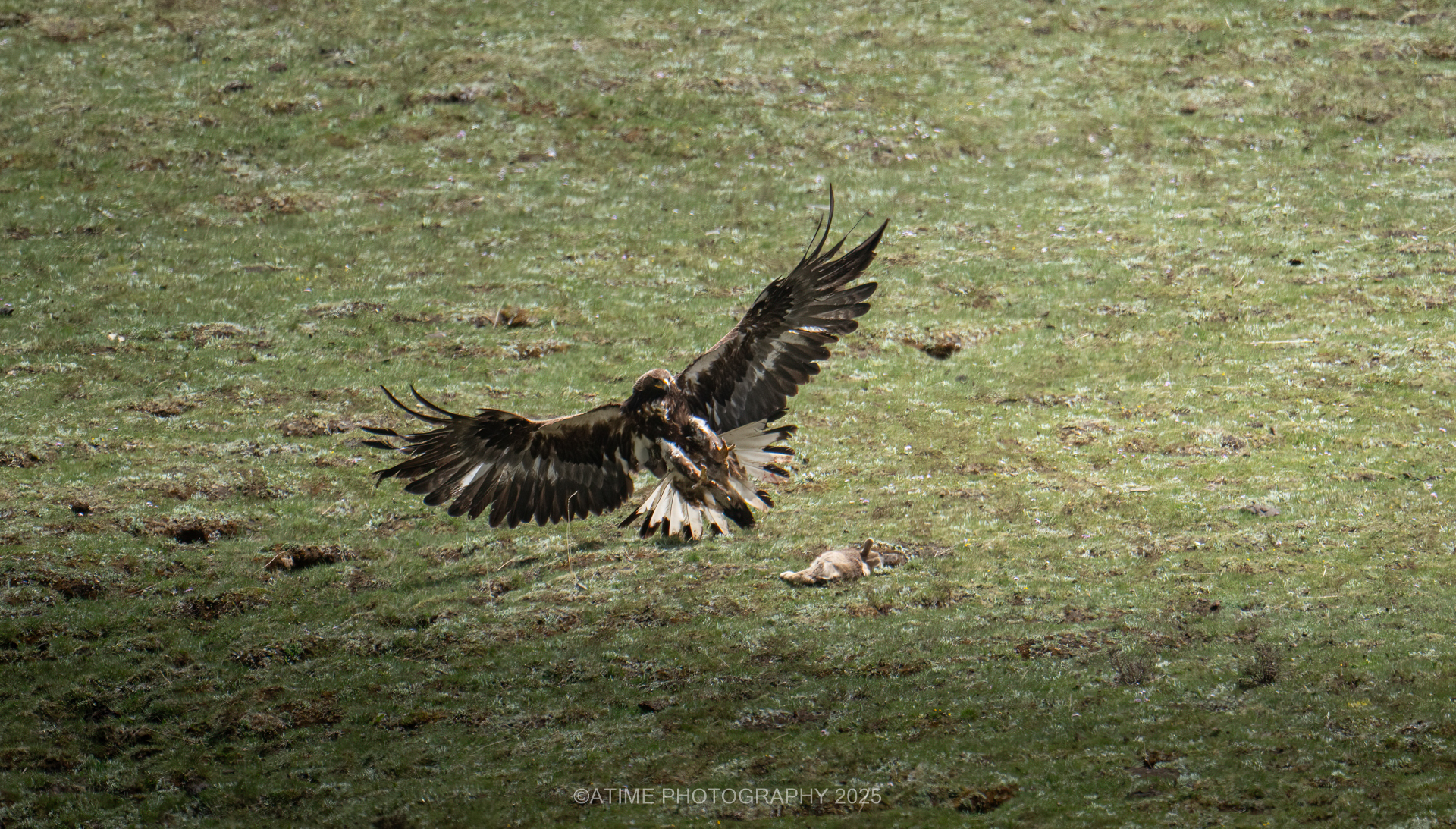
Snow leopard habitat is also home to a remarkable diversity of wildlife. Other cats include Eurasian lynx and Pallas’s cat. The plateau also supports many bird species and offers rewarding bird photography, including Himalayan vulture, bearded vulture, little owl, Eurasian eagle-owl, golden eagle, Himalayan Snowcock, and Tibetan Partridge.
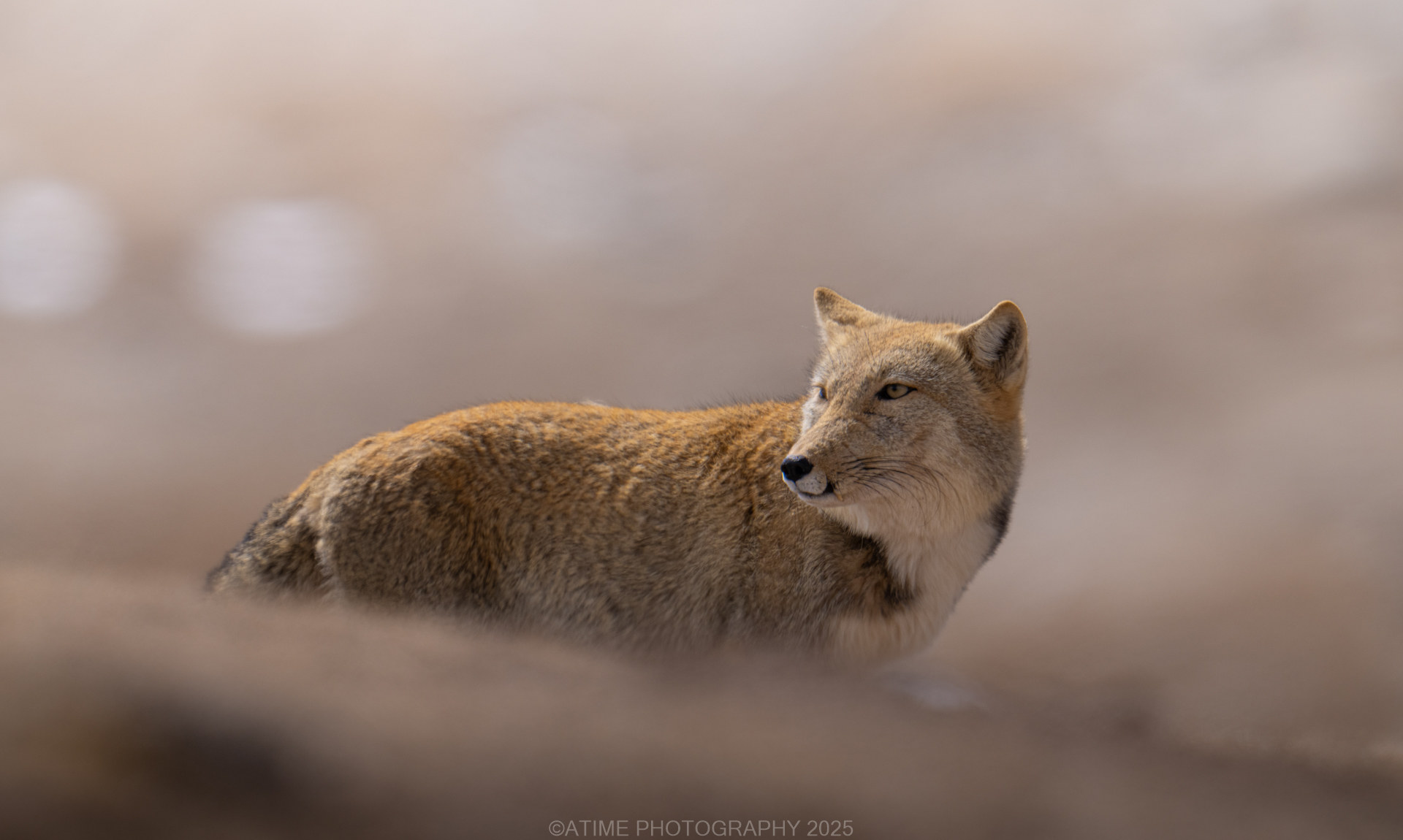
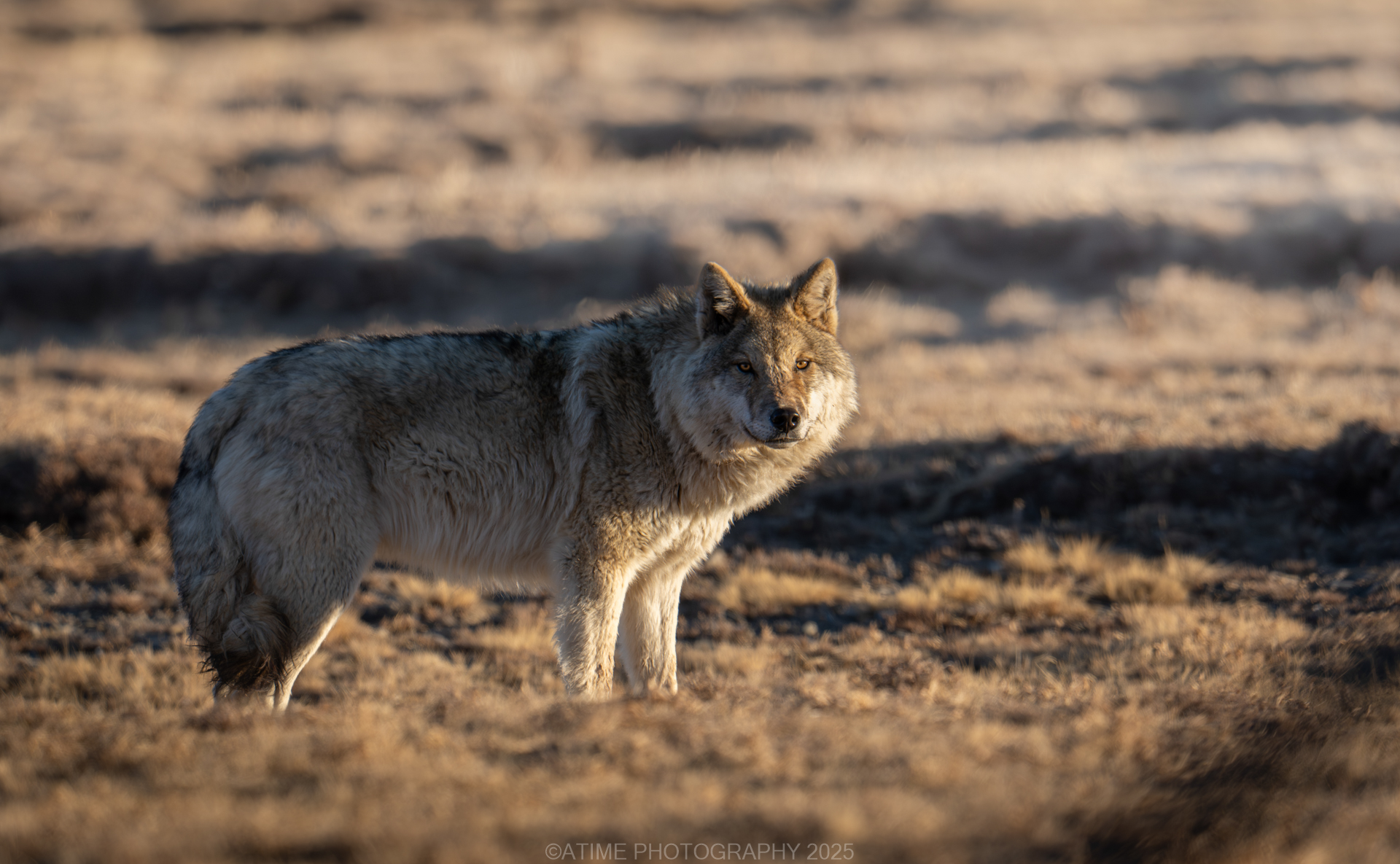
Common ungulates include blue seep, white-lipped deer, Tibetan gazelle, red deer, musk deer and Chinese serow. Depending on the region, photographers may also encounter Tibetan wolf, Tibetan foxes, red fox, and Tibetan brown bears.
Photography tips for two highly sought-after species: Eurasian lynx and Pallas’s cat
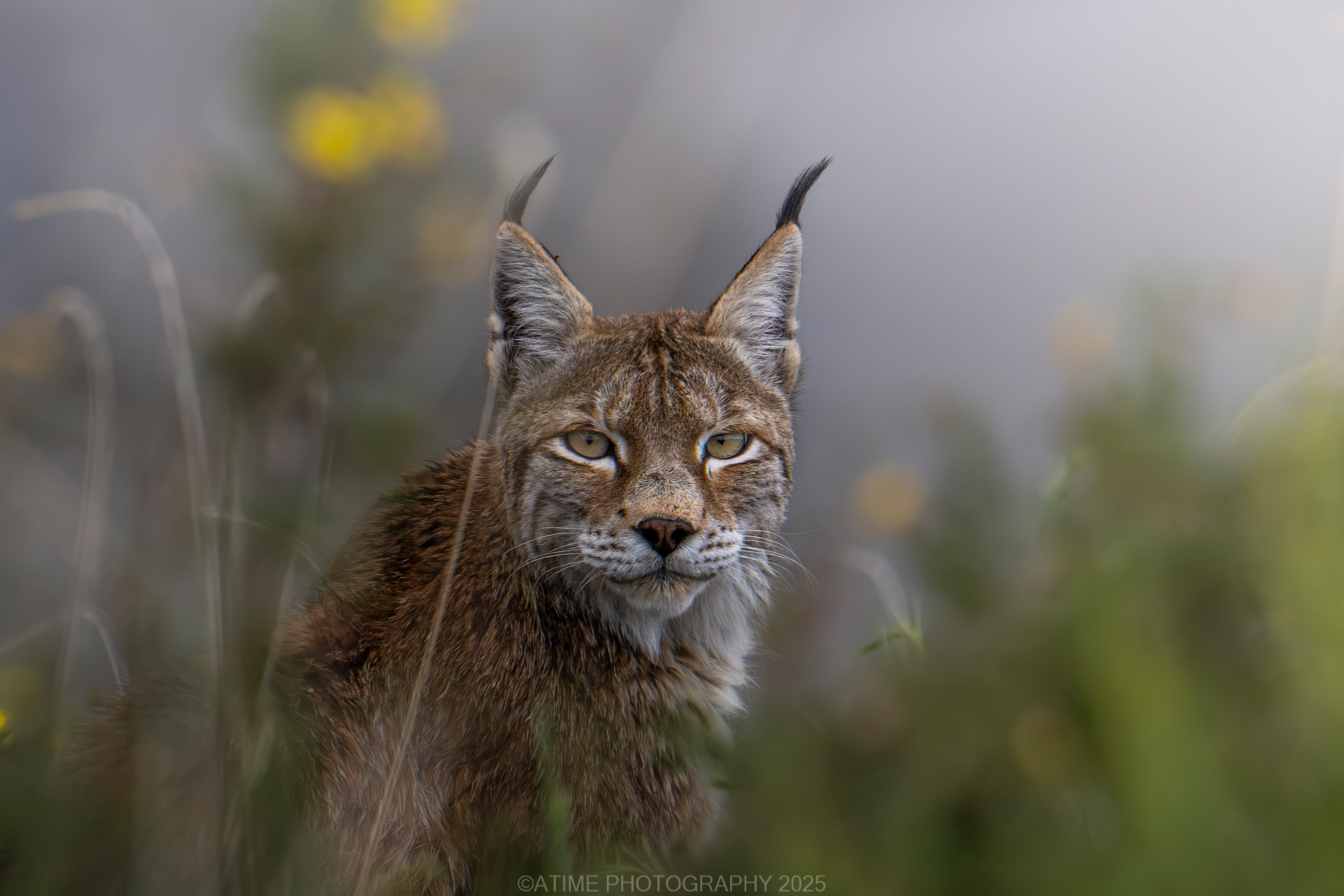
- Eurasian Lynx
Eurasian lynx mainly prey on woolly hares and plateau pikas. They are most active around dawn and dusk, while often retreating into cover to rest during the middle of the day.
Although lynx are more numerous than snow leopards, they can be equally challenging to photograph. Their habit of staying hidden in shrubs and dense vegetation means that getting a full-body image is often difficult. Once a lynx becomes alert, it can quickly disappear back into cover.
When searching for lynx, it is important to keep your camera ready at all times. The moment a lynx appears may last only a few seconds, and the opportunity can disappear before you have time to react.
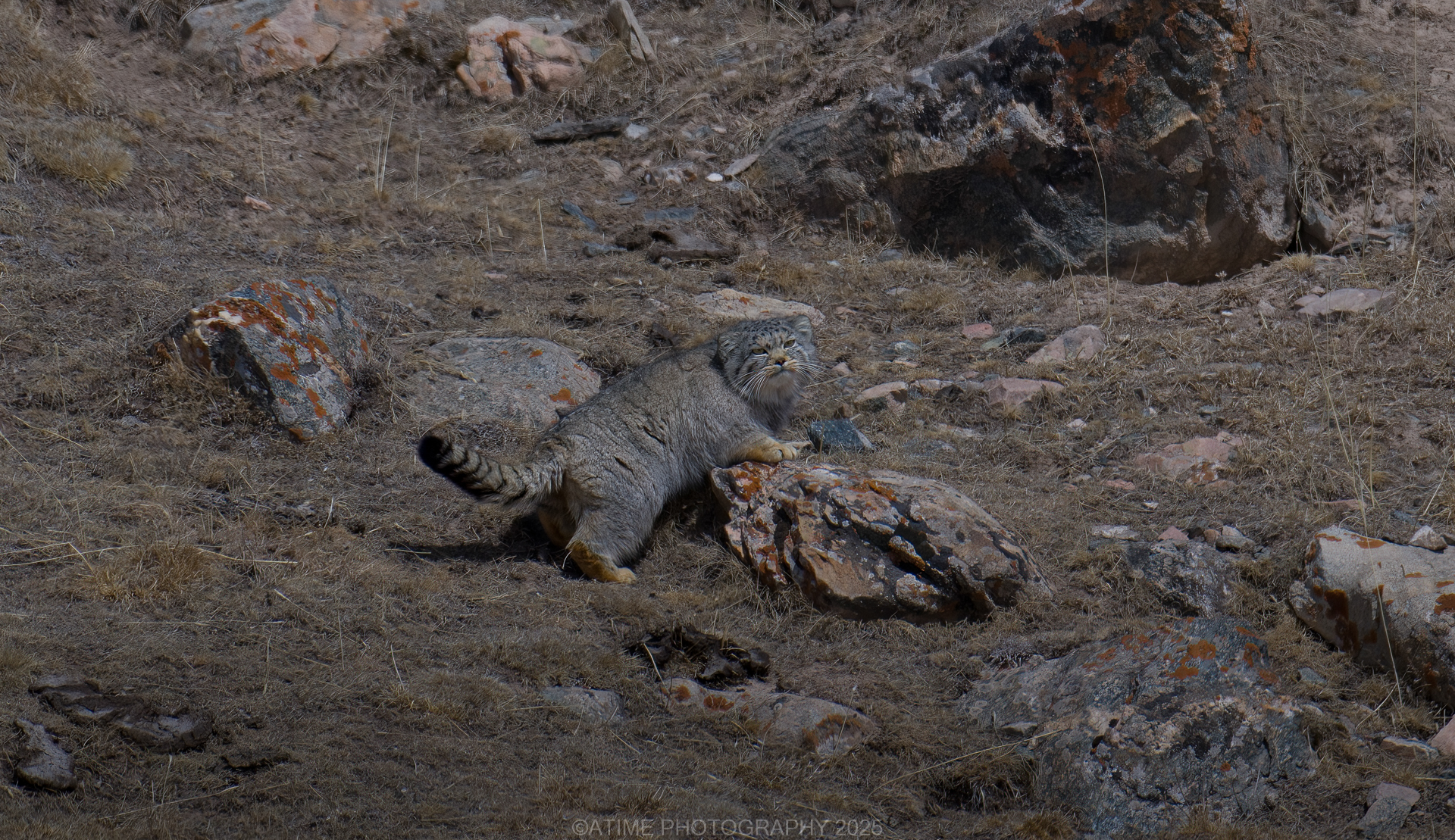
- Pallas’s Cat
Pallas’s cats often hunt pikas and may sometimes remain active during the middle of the day. Their thick fur and natural camouflage allow them to blend almost perfectly into rocky slopes. When a Pallas’s cat remains still, it can be extremely difficult to detect.
Because they often appear in open mountain terrain, photographers may have more time to observe their behavior once they are found. Under suitable conditions, it may also be possible to slowly approach while maintaining a respectful distance.
Speak to our Wildlife Expert
Starting Your Wildlife Expedition to China
Start designing your Wildlife journey with our destination experts.
Make An InquiryField Strategies During a Snow Leopard Expedition
Snow leopards are often first discovered on distant slopes, cliffs, or ridgelines, usually hundreds of meters away. Once a guide locates a snow leopard through a spotting scope, they use natural landmarks such as rocks, gullies, and ridgelines to help photographers identify the animal’s exact position.
Success often depends on an experienced tracking team that can read terrain and predict movement.
If the snow leopard is more than 200 meters away, and the terrain allows, photographers may carefully reposition themselves to improve the shooting angle without affecting the animal’s behavior. This may involve leaving the vehicle for a short hike, while keeping movement quiet and avoiding unnecessary noise.
There is rarely a fixed approach for every encounter. The distance, terrain, and snow leopard’s position are different each time, so flexibility is more important than rehearsing a specific movement plan.
The most important preparation is knowing your own equipment. Being familiar with your camera, telephoto lens, and tripod allows you to set up quickly and quietly, reducing unnecessary movement when a rare opportunity appears.
- Building Long-Term Relationships with Local Guides
Working closely with local guides is one of the most important parts of snow leopard photography. We constantly communicate about recent snow leopard activity, family groups, hunting records, and locations where animals have been spending time, while also building on what we learned from previous trips. When there are no clients in the field, I also join local guides to continue surveying observation areas.
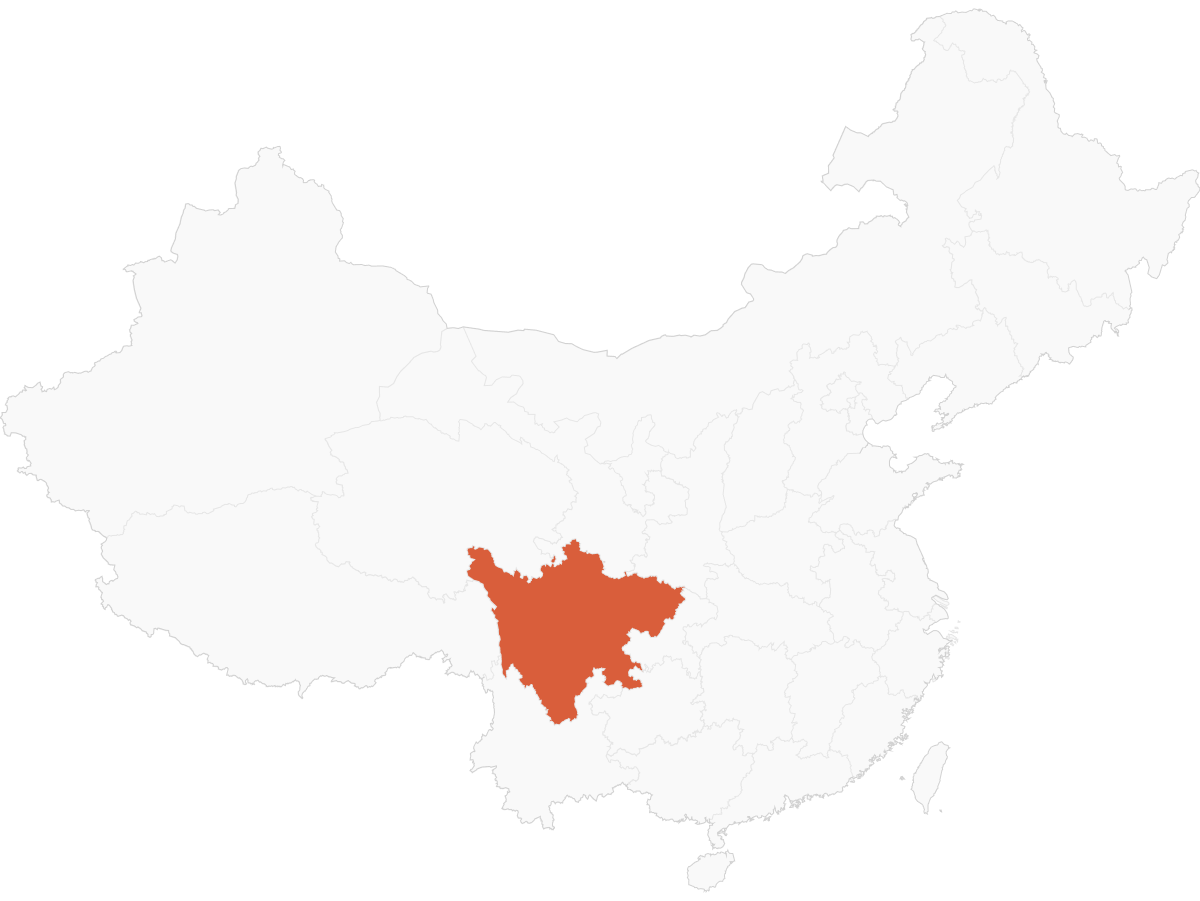
In 2025, I worked with local guides in western Sichuan to locate the den site of an adult female snow leopard with cubs. This area has not yet been opened to international visitors, and we will not disclose its exact location.
After years of observation, you gradually begin to understand where snow leopards prefer to rest and move. A snow leopard may hide behind rocks, on ridgelines, along high ridges, or along the boundary between grass slopes and rocky terrain. Sometimes only the tip of its tail or the fur along its back is visible. It may not reveal its head until it becomes alert. Finding a snow leopard is often not about whether the animal is there, but whether our eyes have learned how to recognize it.
In most situations, guides and photographers can communicate quietly through normal conversation. Special signals are only needed in specific situations, such as waiting silently at a mountain pass for a snow leopard to pass nearby.
The most frequent communication is usually about the animal’s exact position, movement direction, and how to relocate it after it disappears from view. The more time you spend observing snow leopards, the better you understand their behavior and body shape, and the faster you become at recognizing this perfectly camouflaged mountain predator among rocks and grass.
Eastogo offers specialized snow leopard photography expeditions designed for wildlife photographers. Availability is extremely limited each year due to the nature of these locations. Please contact our wildlife experts for details.(CTA)
Best Places to Photograph Wild Snow Leopards
Snow leopards are distributed across 12 countries in Asia, including China, Mongolia, Russia, Kazakhstan, Tajikistan, Kyrgyzstan, Uzbekistan, Afghanistan, Pakistan, India, Nepal, and Bhutan. Among these countries, the majority of organized snow leopard photography expeditions currently take place in China, India, Nepal, and Mongolia.
In this section, I will share several snow leopard photography destinations that I have personally visited and photographed. For more detailed information about observation seasons and expedition conditions in destinations such as Hemis National Park of India, Kyrgyzstan, and Tajikistan, you can also refer to our guide: Best Time to See Snow Leopards: Seasons and Destinations Compared.
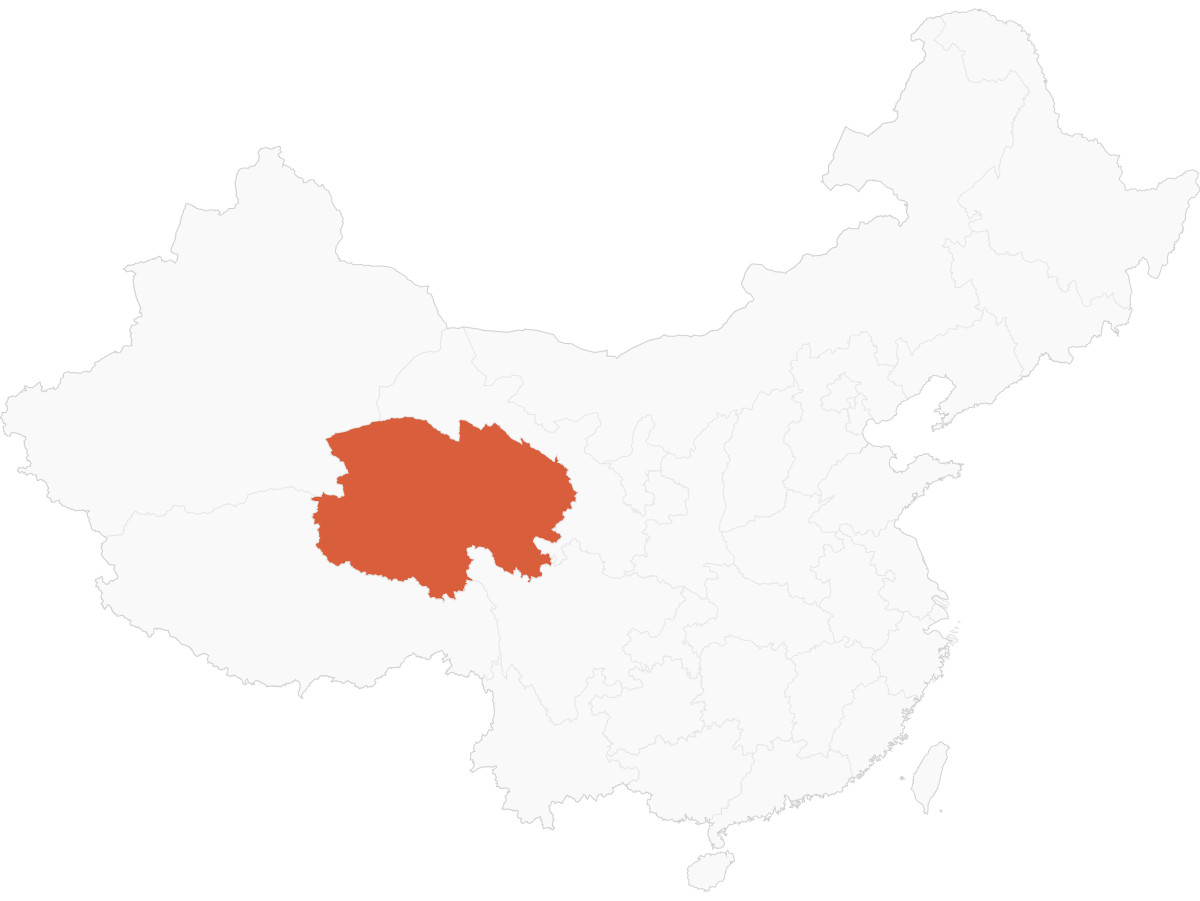
Snow Leopard Photography in Dulan, Qinghai, China
China holds the largest snow leopard population. Dulan in Qinghai offers a broad and dramatic mountain landscape in remote valley, with a balanced mix of rocky terrain and grassland. The relatively open environment and favorable light conditions make it particularly suitable for photographing snow leopards within their high-altitude surroundings.
Most snow leopard encounters here take place at distances of more than 200 meters, making close-up portraits more challenging. Based on field observations, Dulan appears to function more as a route used by snow leopards moving through their territory rather than a core area where they regularly stay and hunt. As a result, sightings are generally less consistent than at another snow leopard site in western Sichuan that remains closed to international visitors.
However, Dulan offers another unique advantage: its rich high-altitude carnivore diversity. The area is also home to species such as the Eurasian lynx and Pallas’s cat, making it one of the few known locations in China where international visitors can potentially photograph all three high-altitude cats in one expedition. This adds significant value and variety to the overall photography experience.
Photographing Snow Leopards, Pallas’s Cats, and Eurasian Lynx in China (12days)
view detailSnow Leopard Photography Tour in Mongolia
Western Mongolia is known for its vast and rugged mountain landscapes. Compared with many other snow leopard destinations, the terrain here often features extensive exposed rock and fewer grass-covered slopes, creating a dramatic wilderness atmosphere. However, the complex mountain terrain can also block natural light, making positioning and exposure decisions more challenging.
In some locations, certain photography operations use bait to attract snow leopards and may use artificial lighting for night photography. These approaches can sometimes result in closer encounters, with animals appearing within around 50 meters of photographers. However, baiting, artificial lighting, and excessive proximity may influence natural behavior and raise ethical concerns.
For photographers who prioritize responsible wildlife practices, it is important to ask operators in advance about their observation methods, including whether they use bait, artificial lighting, or other techniques that may interfere with natural wildlife behavior.
Snow Leopard Photography in Western Sichuan
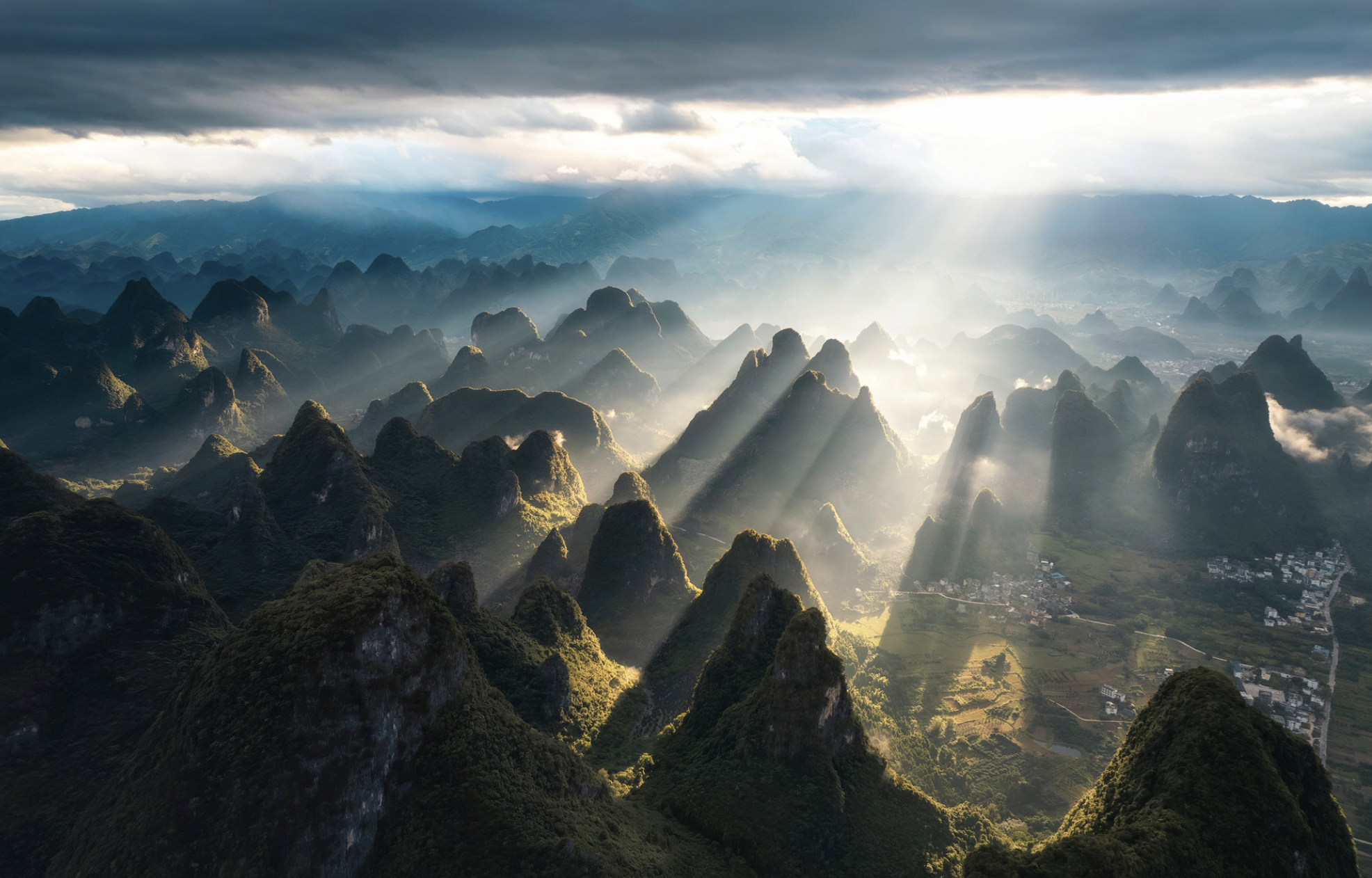
This is one of the snow leopard photography locations I have followed closely over time. The area features extensive exposed grass slopes, with rocky terrain and open landscapes creating favorable conditions for photography. Compared with Dulan, where snow leopards appear more like they are passing through territorial routes, this area serves as both a resting and hunting habitat, resulting in more frequent snow leopard activity.
A relatively stable snow leopard family lives here. At one point, I documented five individuals in the same area, while currently three snow leopards continue to share the same territory. Some individuals show limited reaction to distant human activity and may occasionally pass within 50 meters during natural movements through their territory. However, this depends entirely on the snow leopard’s own behavior. We never actively approach animals or change our position to pursue them.
With favorable natural light, open visibility, and relatively consistent individual activity, this area has strong potential for snow leopard photography. However, the site is not currently open to international travelers, and future access arrangements will depend on local management decisions.
Unlike destinations where international visitors can already photograph snow leopards, encounters within 100 meters remain extremely rare at most established observation sites.
High-Altitude Preparation for Wildlife Photographers
Snow leopard observation is mainly conducted by 4WD vehicles and fixed observation points, with relatively limited walking. No mountaineering experience is required. However, high altitude can increase physical exertion, especially during long periods outdoors. It is recommended to begin basic endurance training, such as jogging, brisk walking, or uphill walking, around one month before the expedition. In the final one to two weeks before departure, reduce or pause intense training to avoid arriving fatigued.
Most snow leopard observation areas are located between 3,700 and 4,500 meters. If time allows, spending one to three days at a lower-altitude location before entering higher areas can help with acclimatization. Possible stops include Xining (2,261 m) or Yushu (3,710 m) before continuing to the observation sites.
After arriving at altitude, maintain a slower pace and avoid strenuous exercise, alcohol, and excessive caffeine intake. Any symptoms such as headache, fever, or diarrhea should be reported to your guide. If symptoms continue to worsen, seek medical attention promptly.
Travelers with heart conditions, respiratory diseases, or other underlying health concerns should consult a doctor before joining a high-altitude expedition.
Long periods of stationary observation can create a greater risk of feeling cold than short walks, so layered clothing is essential beacause of the low temperature:
- A moisture-wicking base layer helps keep the skin dry.
- A fleece or down layer provides insulation.
- A windproof and waterproof outer layer protects against strong mountain winds and snowfall.
- Warm hats, thick socks, insulated footwear, and gloves that still allow camera operation are also important.
Cold temperatures can significantly reduce camera battery life. Carrying several spare batteries is recommended, and keeping them in an inner pocket close to the body helps maintain their performance. When bringing a camera from freezing outdoor conditions into a warm room, place it inside a sealed bag or camera case first and allow it to warm up gradually. This helps reduce condensation on the lens and inside the camera body.
The dry air at high altitude can also make it easy to forget to drink and eat during long observation sessions. Drink water regularly in small amounts and carry convenient high-energy foods such as chocolate, nuts, and energy bars. Maintaining stable energy and concentration is just as important as having the right camera and lenses.
Wildlife Photography Ethics and Conservation
Photographing a snow leopard comes with a responsibility to protect the animal, support wider conservation efforts, and respect the environment that makes the encounter possible.
- Maintain a respectful distance
Snow leopards are wild predators, and keeping a safe distance protects both the animal and the photographer. Any approach should never alter the snow leopard’s natural behavior. Always watch for signs of alertness and increase distance if the animal becomes disturbed.
- Never bait or interfere with wildlife
Do not use food, sounds, or any other method to attract a snow leopard. Baiting can change natural behavior and may affect both the animal and future wildlife encounters.
- Avoid dens and cubs
If you discover signs of cubs or a den site, leave the area immediately. Never track, wait nearby, or reveal the location.
- Leave no trace
Take everything you bring into the mountains back with you. Do not leave rubbish, strong scents, or any other signs of human presence behind.
- Follow the guidance of local experts
Local herder guides have lived alongside snow leopards for generations. Their knowledge of the landscape, wildlife behavior, and Tibetan traditions of coexistence is invaluable. They understand when to move closer, when to wait, and when to leave. In the field, their judgment should always be respected.
- Choose expeditions that support local communities
Local communities are an essential part of snow leopard conservation. Many herders live alongside these animals and provide the local knowledge that makes responsible wildlife observation possible, especially in extreme environments where wildlife and livelihoods are closely linked. When tourism creates meaningful benefits for communities, it can become a long-term incentive for protecting snow leopards and their habitat.
A snow leopard photograph is not just about capturing a rare moment. Trust between people and wildlife is built through long-term respect. Without that respect, snow leopards will simply choose another path.
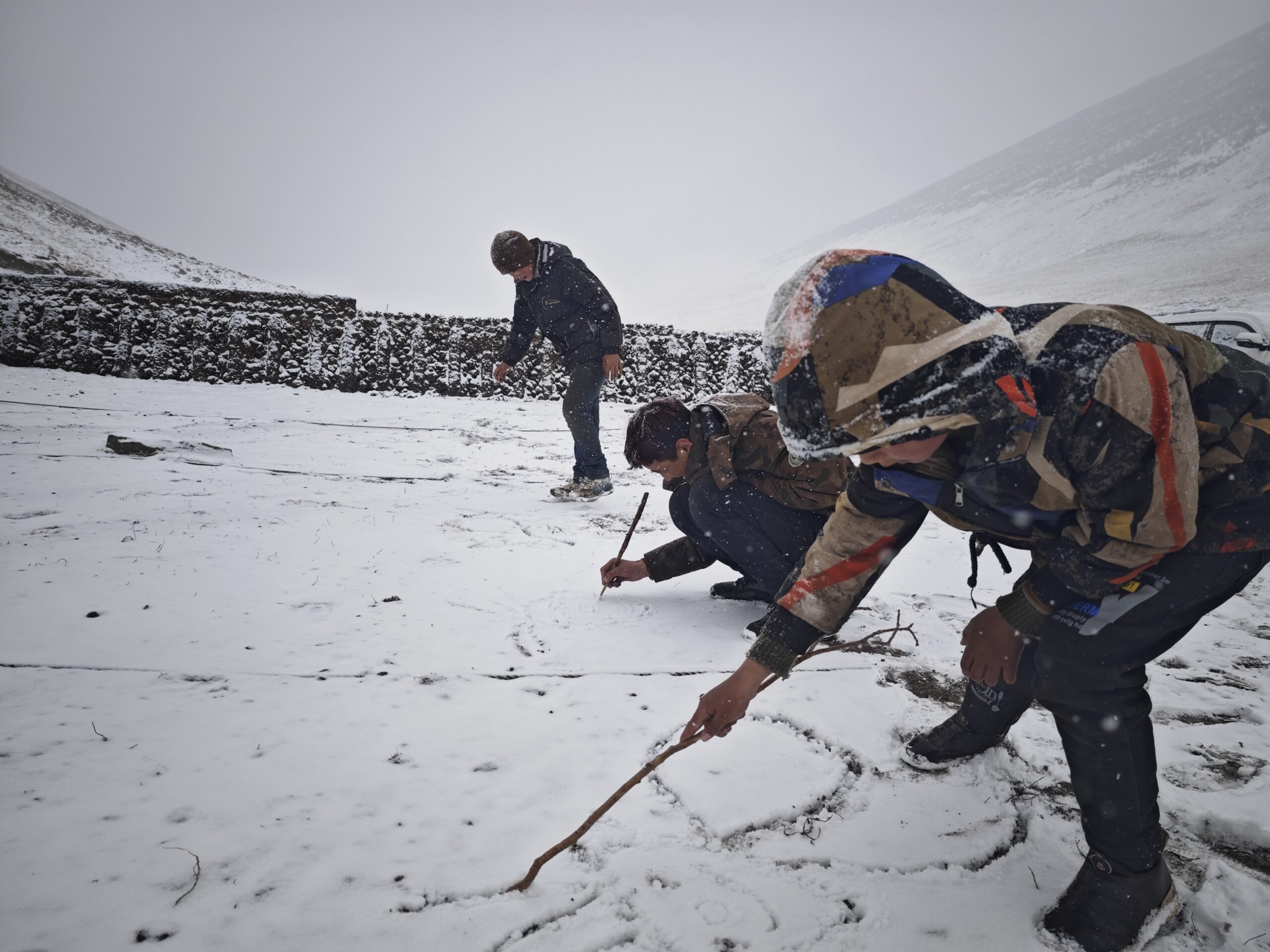
Field Workflow: Managing Photos During an Expedition
A good habit during a wildlife photography expedition is to back up your images every evening after shooting. Transfer all photos from your camera memory cards to a portable hard drive or computer, then clear the cards for the next day’s work.
In remote areas without reliable electricity or access to a computer, the strategy is different. Carry additional memory cards and store them carefully. Memory cards are fragile, so they should be kept protected inside a compartment of your camera bag.
For expeditions involving tent camping without charging facilities, the same principle applies. Focus on protecting your data and ensuring that your camera batteries are fully charged and ready for the next day’s photography.
Post-Processing Snow Leopard Images
Noise Reduction for High ISO Images
Snow leopard photography often takes place in challenging light conditions, which means images are frequently captured at high ISO settings. A common approach today is to use AI noise reduction tools in Camera Raw to achieve cleaner images.
However, noise reduction always involves a trade-off. While it can significantly reduce noise, it may also remove some fine details and affect image quality. The key is finding the right balance by adjusting the strength of the effect rather than applying it too aggressively.
Maintaining Natural Fur Colors
Maintaining the natural color of a snow leopard’s fur is important. Despite its name, a snow leopard’s coat is not pure white. Its natural color often has a subtle yellowish tone, partly influenced by years of exposure to sunlight and weather.
In most cases, preserving this natural warm tone creates a more authentic image. Of course, some photographers choose to create more stylized interpretations by adjusting the fur toward a lighter white appearance, and this can also be a valid creative choice.
Cropping Distant Snow Leopard Images
Because snow leopards are often photographed from long distances, even an 800mm lens combined with a teleconverter may still leave the animal appearing relatively small in the frame. This is where high-resolution camera bodies become particularly valuable.
Today’s flagship cameras from the three major brands generally provide enough resolution to allow significant cropping while maintaining usable image quality. In many situations, a crop of around 30% is still achievable.
Snow Leopard Photography Shot List
- Winter: Snow, Lower Elevations, and Courtship Behavior
Snow leopards can be photographed throughout the year, but winter often provides some of the most distinctive opportunities. Snowfall can occur across the plateau from October to early May, although mountain weather changes quickly and snow cover often does not remain for long periods.
During winter, snow leopards may move closer to lower elevations where prey is more accessible, creating more opportunities for observation. Hunting behavior can occur in any season, but snowy landscapes often create more dramatic images. The best time to photograph snow leopards is from November through April.
From January to March, snow leopards enter their breeding season, offering opportunities to photograph courtship behavior and, in rare cases, mating interactions.
- Spring: Marmot Hunting Opportunities
Around May, Himalayan marmots begin emerging from hibernation. In some regions, snow leopards take advantage of this seasonal food source, creating opportunities to photograph marmot hunting behavior.
- Summer: Blue Sheep and Hunting Scenes
Summer, especially July, coincides with the blue sheep birthing season. During this period, young prey may increase hunting opportunities, and snow leopards may have higher hunting success.
Practical Packing Checklist for Snow Leopard Photographers
- Camera Bodies
- Sony: Alpha 9 (A9) or Alpha 1 (A1)
- Canon: EOS R1
- Nikon: Z9
- Super-Telephoto Lenses
- Sony: FE 600mm
- Canon: 800mm f/5.6
- Nikon: 800mm f/5.6
- Support
- Tripod: Gitzo
- Gimbal head: Sachtler
- Essential Accessories
- Teleconverter
- Spare batteries
- Camera rain cover
In most situations, there is no need to carry every piece of equipment into the field. Prioritize protecting the camera body and main lens, and keep spare batteries and a rain cover with you during daily observation.
- Clothing
- Moisture-wicking thermal base layers
- Fleece or lightweight down mid-layer
- Waterproof heavy down jacket or other insulated cold-weather outerwear
- Windproof and waterproof shell
- Warm trousers and windproof outer pants
- Windproof insulated hat or a hat that covers the ears
- Scarf or neck gaiter
- Inner gloves and thick insulated gloves
- Sufficient warm socks
- Footwear
- Waterproof, slip-resistant hiking boots or winter outdoor footwear with good ankle support
- Soles suitable for rocky terrain, frozen ground, and light snow
- Break in your footwear before departure; avoid taking brand-new boots directly into the mountains
- Depending on winter conditions, consider gaiters or insulated insoles
- High-Altitude and Daily Essentials
- High-SPF sunscreen
- UV-protection sunglasses
- Outdoor sun hat
- Lip balm and moisturizer
- Insulated water bottle
- Personal medications
- Small personal first-aid kit
- Disposable or reusable hand warmers
- Headlamp
- Power bank
- Wet wipes and basic personal hygiene items
- Four – season sleeping bags for itineraries with camping or unheated overnight stays
- Medications and Supplements to Discuss With Your Doctor
- Paracetamol, caffeine and aspirin powder (阿咖酚散)
- Acetazolamide
- Glucose
Always consult your doctor before taking any medication for altitude-related symptoms or prevention.
Planning Your Snow Leopard Photography Expedition With Eastogo
China holds the largest area of snow leopard habitat in the world and is home to more snow leopards than any other country. For anyone hoping to photograph this species in the wild, it is a destination that should not be overlooked.
Eastogo’s wildlife team brings together different kinds of field experience. Some of our experts have worked on snow leopard observation for documentary projects including Disney, National Geographic, and Frozen Planet. Others have spent much of their lives in snow leopard habitat and know the wildlife around their communities intimately. Our team also includes award-winning professional wildlife photographers whose work grew from a lifelong passion for wild animals.
Over the years, we have explored and developed several snow leopard observation locations. Our snow leopard photography tours are currently based in Dulan, Qinghai, where I personally lead expeditions designed for wildlife photographers. We offer scheduled small-group departures as well as private tours tailored to individual photography goals and interests.
Speak to An Expert
Starting Your Snow Leopard Photography Jounrney to China
Start designing your snow leopard photography journey with our destination experts.
Make An InquiryIn these remote mountains, local herders are often the people who understand snow leopard movements most intimately. Their knowledge forms the foundation of our wildlife network and makes responsible observation possible on any snow leopard photography tour across this part of Central Asia.
We hope each expedition contributes to more than photographs: creating lasting value for the communities that share this landscape with snow leopards, while keeping the animals free to move, hunt, and live on their own terms.
Further Reading
China remains one of the most underrated destinations for snow leopard photography. To learn more about observation regions across the country, you can explore our China Snow Leopard Complete Guide. Based on our experience, Dulan remains one of the best snow leopard photography destinations in China currently open to international travelers.
You can also join our 8-day snow leopard tour in Qinghai, developed together with local Tibetan guides. Designed for adventurous travellers, it offers a more affordable way to experience snow leopard tracking while staying closely connected to the local communities and landscapes. Eastogo can also customize unique itineraries that combine snow leopard photography with immersive Tibetan cultural experiences.
Beyond snow leopards, China is home to an extraordinary diversity of wildlife. Explore more wild China tours with our wildlife experts and discover the country’s remarkable natural landscapes and species.
Reference
[1] Wei, C., Liu, Y., Liang, M., Chang, M., Yu, Y., Gao, Y., Jikmed, A., Li, X., Li, J., Bian, X., Yu, C., Li, Y., Xue, Y., Xing, R., Xiong, X., Liang, B., Li, S., Wang, H., Zhao, X., … Xiao, L. (2026). Snow leopard (Panthera uncia) status in China. Snow Leopard Reports, 5(1), 81–95. https://doi.org/10.56510/slr.v5.65095